
AI’s Future: How Artificial Intelligence Will Change the World
Artificial Intelligence is now part of everyday conversations. But at the same time, it leaves many people amazed and unsure about what’s coming next.
Questions are popping up everywhere: What impact will AI have on our lives? Will it replace human jobs or create new ones? How will it transform fields like healthcare, education, finance, and entertainment? Is it something we should trust or worry about?
And can it ever match or even exceed human intelligence? From students to professionals and across social media, everyone is trying to understand it better. The interest is growing fast, and so is the need for clear answers.
That’s why I’ve put together this detailed guide on the future of AI. It’s carefully explained, easy to follow, and full of important insights.
Let’s dive in and see what the future of AI really looks like.
Evolution of AI (Past → Present → Future)
Before we explore what lies ahead, it’s important to understand how Artificial Intelligence has developed over time. AI didn’t become powerful overnight — it grew step by step, starting from basic ideas to the advanced systems we see today.
Let’s break it down in a simple and clear timeline.
Early Stage of AI (The Beginning)
In the beginning, AI was not intelligent in the real sense. It simply followed fixed rules given by humans. The goal was to make machines behave logically, not creatively.
- 1950 – The Turing Idea: Alan Turing introduced a simple but powerful question: Can a machine behave like a human?
- 1956 – Birth of AI Field: At the Dartmouth Conference, the term Artificial Intelligence was officially introduced, marking the start of AI as a scientific field.
- 1966 – First Chat Program: ELIZA became one of the first chat systems, responding to users using simple text patterns.
- 1980s – Rise of Expert Systems: AI began assisting professionals. It was used in healthcare for diagnosis and in finance for data handling.
- 1997 – Chess Breakthrough: Deep Blue defeated Garry Kasparov, proving that machines can handle complex decision-making.
- 2011 – AI Understands Language: IBM Watson won the quiz show Jeopardy!, showing strong language understanding skills.
- 2012 – Deep Learning Growth: AI systems began using neural networks to recognize images and speech with much higher accuracy. This marked the beginning of modern AI.
AI Today (2022–2026)
Now AI has moved far beyond basic tasks. It can understand, create, and even make decisions with minimal human input.
- 2022 – Creative AI Tools: ChatGPT made AI accessible to everyone for writing, coding, and idea generation.
- 2024 – Multi-Ability AI: AI systems like GPT-4o and Gemini 1.5 can process text, images, audio, and video together.
- 2025 – AI Regulations Begin: Governments started creating rules such as the EU AI Act to ensure safer AI usage.
- 2026 – Action-Based AI: AI systems can now perform real-world tasks like scheduling, booking, managing workflows, and controlling machines in industries.
- Smart Wearables: AI is no longer limited to screens. It is now part of wearable devices like smart glasses that can understand surroundings in real time.
Future of AI (2030–2080)
Looking ahead, AI is expected to become much more powerful and deeply connected with human life.
- 2030 – Human-Level Intelligence (AGI): AI may reach a level where it can learn and perform tasks just like humans.
- 2035 – Robots in Daily Life: Intelligent robots could become common in homes, hospitals, and workplaces, handling physical tasks.
- 2040 – Self-Upgrading Systems: AI may start improving itself without human coding, becoming smarter at a rapid pace.
- 2050 – Brain + AI Integration: Technologies like Brain-Computer Interface could allow humans to connect directly with AI.
- 2060 – Abundant Resources: AI-driven systems may make production cheaper, reducing global poverty and increasing access to resources.
- 2080 – Advanced Global Intelligence: AI could help manage climate systems, control environmental challenges, and support space exploration beyond Earth.
Key Factors Shaping the Future of AI
Now that we’ve seen how AI has developed over time, let’s focus on what is actually pushing it forward today. These are the core forces that are accelerating AI growth and making it more advanced every year.
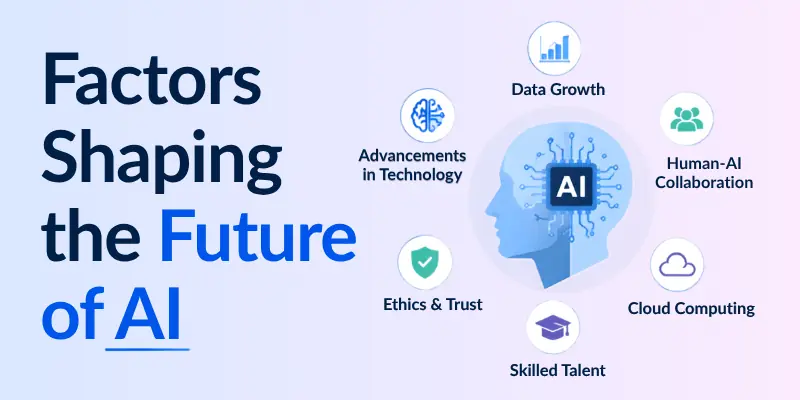
Here are the main drivers explained in simple terms:
- Advanced Computing Power: Modern processors and high-performance chips are making AI systems faster and more capable. With stronger hardware, AI can handle complex tasks and process huge amounts of information quickly.
- Massive Data Availability: AI improves by learning from data. Today, data is being generated everywhere, from smartphones, websites, sensors, cameras, and digital platforms, which helps AI become smarter over time.
- Online Cloud Infrastructure: Businesses no longer need expensive setups to use AI. Platforms like Google Cloud, Amazon Web Services, and Microsoft Azure allow companies to access AI tools easily through the internet.
- Self-Learning Algorithms: Technologies such as machine learning and deep learning enable systems to improve automatically by identifying patterns and making predictions without constant human input.
- Smart Machines & Automation: AI is being integrated into robots and automated systems. These machines are now assisting in industries like healthcare, manufacturing, and agriculture, reducing manual effort.
- Content-Creating AI Tools: Modern AI systems like ChatGPT, Gemini, and Claude can generate text, visuals, and ideas, transforming how people work and create.
- Connected Smart Devices: With the growth of the Internet of Things, everyday objects like home appliances and vehicles can now communicate and make intelligent decisions using AI.
- Regulations and Policies: Governments around the world are introducing guidelines and laws to control how AI is used, ensuring safety, privacy, and ethical practices.
- Heavy Investment in AI: Large tech companies and startups are investing huge amounts of money into AI research and development, speeding up innovation.
- Need for Speed and Efficiency: Organizations want faster results, fewer errors, and lower costs. AI helps achieve this, increasing its demand across industries. Many businesses also work with a custom ai development company to build tailored AI solutions for their specific needs.

How AI Will Transform the World: Major Future Impact
As we move deeper into 2026 and beyond, Artificial Intelligence is no longer just a concept of the future; it is already reshaping how the world operates. From businesses to education, healthcare to daily routines, AI is becoming a core part of everything around us.
And the numbers clearly show this shift:
- Nearly 80% of companies worldwide are planning to increase their AI spending by 2026 to stay competitive.
- Around 100 million professionals are expected to be working in AI-related roles by 2025–26.
- AI is predicted to generate 170 million new jobs globally by 2030, even though it will transform or replace some existing roles.
Now let’s explore how different industries are being impacted by AI, with the latest data and real-world influence:
- Healthcare: The AI healthcare market has reached $56 billion in 2026. AI is dramatically speeding up drug development, reducing timelines from 5 years to just 12 months, while diagnostic systems are achieving 98% accuracy.
- Finance: AI in finance has crossed $35 billion in market value. Advanced systems can now detect and stop 99% of fraudulent activities within milliseconds, while also managing fully automated investment portfolios around the clock.
- Manufacturing: AI is expected to contribute $3.8 trillion in value by 2035. Smart maintenance systems powered by AI can reduce equipment downtime by up to 50% using live sensor data.
- Energy & Utilities: Energy systems powered by AI have improved grid reliability by 30%. AI can instantly detect faults and prevent large-scale power outages, especially in smart city environments.
- Cybersecurity: AI-driven cybersecurity spending has reached $51 billion in 2026. Intelligent systems now handle 80% of threat responses automatically, protecting against advanced cyberattacks.
- Retail: Retail businesses are investing $35.9 billion in AI technologies. AI systems can now predict when products will run out and automatically reorder them, making fully automated shopping a reality.
- Education: AI is improving student performance by 30%. Personalized AI tutors and AI translation tool are now capable of adapting lessons based on each student’s learning speed and understanding.
- Customer Service: Around 70% of customer issues are now resolved instantly using AI. Modern voice systems can even detect emotions and respond with appropriate tone and empathy.
- Real Estate: About 42% of real estate companies are using AI tools. Predictive systems can estimate property returns with up to 90% accuracy, along with offering advanced virtual tours.
- Tourism & Hospitality: The AI market in tourism has reached $1.2 billion. AI is managing everything from automated check-ins using facial recognition to real-time pricing updates for hotels.
- Legal Services: Legal firms have increased tech spending by 40%, with AI now handling 60% of document analysis and case research, allowing lawyers to focus more on strategy.
- Media & Journalism: AI is responsible for producing nearly 30% of news content, especially in areas like financial and sports reporting, while human journalists focus on deeper investigations.
- Marketing: Businesses using AI have seen a 22% increase in cross-selling revenue. AI can generate millions of personalized ads instantly based on user behavior and preferences.
- Fashion Industry: The AI fashion market is valued at $3.9 billion. Smart virtual fitting tools allow nearly 100% accurate try-ons, reducing product returns by 25%.
- Gaming & Entertainment: AI is adding around $150 billion in value to this sector. Games now feature dynamic characters that can interact with players in real-time conversations.
- Agriculture: AI in agriculture has reached a $3.1 billion market size. Precision farming techniques are increasing crop production by 35% while reducing water and chemical usage by 40%.
- Logistics & Supply Chain: About 40% of logistics operations are now automated. AI systems can adjust shipping routes, negotiate prices, and respond to delays without human involvement.
- Automotive Industry: The automotive sector is investing $70 billion annually in AI. In smart cities, AI-enabled systems have helped reduce traffic accidents by 45%.
- Construction: The construction AI market stands at $2.1 billion in 2026. AI helps cut planning time by 50% and improves safety by detecting risks through real-time monitoring.
- Government & Public Sector: Around 67% of countries are actively using AI in governance. AI is widely used for detecting tax fraud and improving disaster response systems for events like floods and wildfires.
Benefits of Future AI
Here are the future benefits of artificial intelligence:
- Faster Work & Less Repetition: AI saves time by handling repetitive tasks like writing, summarizing, and drafting.
- Better Healthcare: AI helps detect diseases early and improves diagnosis accuracy.
- Personalized Learning: AI delivers customized lessons based on each student’s pace and needs.
- New Jobs & Careers: AI creates new roles such as AI specialists, prompt engineers, and data experts.
- Smarter Business Decisions: AI helps companies predict trends and make quicker, data-driven decisions.
- Everyday Convenience: AI simplifies daily life by managing tasks, reminders, and recommendations.
- Lower Costs & Efficiency: AI reduces errors, saves resources, and improves productivity across industries.
- Better Environment: AI supports climate monitoring and helps reduce waste and energy usage.
- Safety & Disaster Help: AI assists in emergency response during natural disasters to save lives.
- Boost Creativity: AI helps generate ideas for writing, design, music, and other creative work.

Risks & Challenges of Future AI
Here are the future risks of artificial intelligence:
- Job Loss Concerns: AI may replace repetitive jobs, requiring people to learn new skills.
- Unfair or Biased Decisions: AI can produce biased outcomes if trained on biased data.
- Privacy Problems: AI systems may collect and misuse personal data without proper consent.
- Fake Content & Deepfakes: AI can generate realistic fake media that may spread misinformation.
- Cybersecurity Threats: AI can be used by hackers to launch attacks and steal data.
- Autonomous Weapons: AI-powered weapons could operate without full human control.
- Overdependence on AI: Excessive reliance on AI may reduce human thinking and problem-solving ability.
- Weak AI Rules & Laws: Lack of proper regulations can lead to unsafe or unethical AI use.
- Environmental Impact: Training large AI models consumes significant energy and increases emissions.
- Unknown Future Risks: Advanced AI may behave unpredictably in ways we cannot fully control or anticipate.
Regulation, Governance & Ethical AI
The early, less controlled phase of AI is ending. Now, AI must follow clear rules to ensure it is safe, fair, and reliable for everyone.
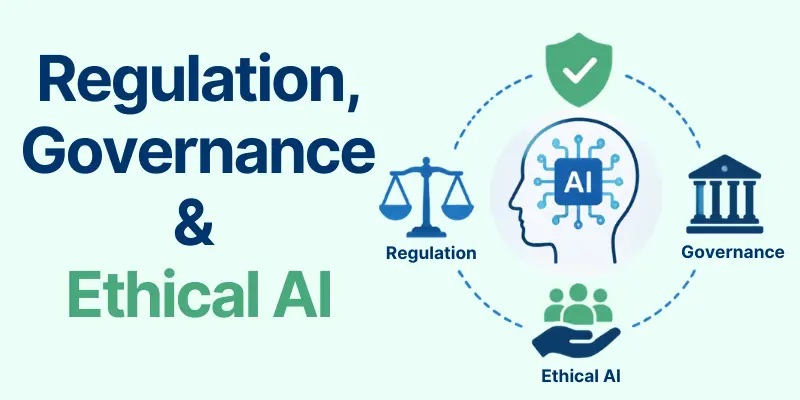
Here’s how this is happening:
- Regulation (Laws & Rules): Governments are creating strict AI laws. In regions like Europe, high-risk AI must be tested and approved before use. In the United States, some states like Texas and California have laws to limit deepfakes and improve AI safety.
- Governance (Control & Responsibility): Companies are adding teams and roles, like Chief AI Officers, to monitor AI use. Some also use AI insurance, which requires proper testing before deployment.
- Ethical AI (Doing the Right Thing): AI is designed to follow human values. It should help people and avoid harmful or unsafe outputs.
- Transparency & Explainability: AI decisions should be easy to understand. Users should know why a decision was made, and AI-generated content must be clearly labeled.
- Fairness & Bias Control: AI can sometimes be biased due to its data. Companies check for bias (gender, age, race) to ensure fair results. Unfair AI use can lead to penalties.
- Human-in-the-Loop (HITL): In important areas like healthcare and law, humans make the final decision while AI only assists.
- Global Collaboration: Countries are working together to set common AI safety rules. Many nations are joining efforts to promote safe and responsible AI use worldwide.
How Society Can Prepare for the Future of AI
As AI continues to grow rapidly, it’s important for individuals to adapt and prepare for the changes it brings. Here are some practical ways to stay ready:
- Stay Informed: Follow updates, news, and developments in AI.
- Build AI Knowledge: Learn the basics through online courses or tutorials.
- Use AI Tools: Practice with AI applications in real-life tasks or projects.
- Keep Improving Skills: Focus on creativity, critical thinking, and technical abilities.
- Adapt to Change: Be flexible in adopting new tools and technologies.
- Protect Personal Information: Understand how to manage and secure your data online.
- Work Alongside AI: Learn how to combine human skills with AI capabilities effectively.
- Use AI Responsibly: Follow ethical practices when using AI tools.
- Plan Ahead: Consider AI trends when making career or education decisions.
Final Thoughts
In this guide we have covered the future of AI with great updated stats and research. AI is growing very fast and it will change almost every industry in the coming years. From healthcare and education to business and technology, AI will continue to improve how people work and solve problems.
In my opinion, AI will update each and every field very quickly. The people who learn AI tools and update their skills will be able to move to the next level. However, those who stay only with traditional methods may face many difficulties in the future.
So always try your best to learn new AI technologies in your niche. Mix your skills with AI tools and see how you can make yourself stronger and more prepared for the future. I hope you found this article helpful. If you liked it, feel free to share your thoughts in the comments below.
FAQs
Here are some of the most frequently asked questions related to AI’s future:
The future of AI is expected to be more advanced, safe, and widely used in everyday life. AI will support industries like healthcare, education, and business with automation and smart decision-making. It will also focus on fairness, transparency, and human collaboration. Overall, the direction of future of ai is toward smarter and more responsible systems.
AI plays a key role in shaping innovation and solving complex problems.
- Enhances efficiency and accuracy
- Supports healthcare and education
- Enables new technologies and solutions
- Connects with ai and the future of global development
AI will automate repetitive tasks but will not completely replace humans. Many roles will evolve, and people will work alongside AI tools. New job opportunities will also emerge as technology grows. This shows how artificial intelligence is the future of work rather than a full replacement of humans.
AI is continuously improving with better data, models, and algorithms.
- Becoming more intelligent and adaptive
- Increasing real-world applications
- Improving user interaction
- Expanding rapidly as part of ai's future worldwide
In the next five years, AI will become more integrated into apps, devices, and services. It will be faster, more accurate, and more personalized for users. Automation will expand across many industries. This helps explain where will ai be in 5 years as highly advanced and widely adopted.
AI is becoming a core part of modern technology and innovation.
- Powers automation and smart systems
- Used in apps, devices, and platforms
- Improves productivity across industries
- Shows that ai the future of technology is highly likely
Examples include self-driving cars, AI-powered healthcare tools, smart homes, and advanced chatbots. AI will also be used in fraud detection, education, and content creation. These innovations show the practical side of future artificial intelligence in real-world applications.
AI helps businesses operate faster and more efficiently.
- Automates repetitive tasks
- Improves data-based decisions
- Enhances customer support
- Reduces costs and saves time
AI will make daily life easier through smart assistants, recommendations, and automation. It will assist in navigation, shopping, healthcare, and communication. People will rely more on AI tools for quick and accurate results. This reflects how ai for the future aims to improve convenience and efficiency.
AI also brings challenges that need proper control and regulation.
- Privacy and data security issues
- Bias and unfair outcomes
- Job disruption in some sectors
- Possible misuse of AI systems
- ✔ Be Respectful
- ✔ Stay Relevant
- ✔ Stay Positive
- ✔ True Feedback
- ✔ Encourage Discussion
- ❌ Avoid Spamming
- ❌ No Fake News
- ❌ Don't Copy-Paste
- ❌ No Personal Attacks