
Future Technology Trends in Healthcare: Smart Hospitals
Technology has changed many industries around the world. From education and banking to transportation and communication, digital innovation is improving how people work and live.
Businesses now rely on modern systems, automation, and data tools to improve speed and efficiency. As technology continues to grow, every sector is seeing major improvements.
Healthcare is also experiencing this transformation. Hospitals, clinics, and medical researchers are now using advanced tools, artificial intelligence, and smart systems to improve patient care. This shift shows how technology and innovation in healthcare are shaping the way doctors diagnose diseases, treat patients, and manage hospitals.
In this guide, we will explore the future technology trends in healthcare and how these innovations will improve the health care in future.
Future Technology Trends in Healthcare
Below are the future technology trends in healthcare that are expected to shape the health of the future.
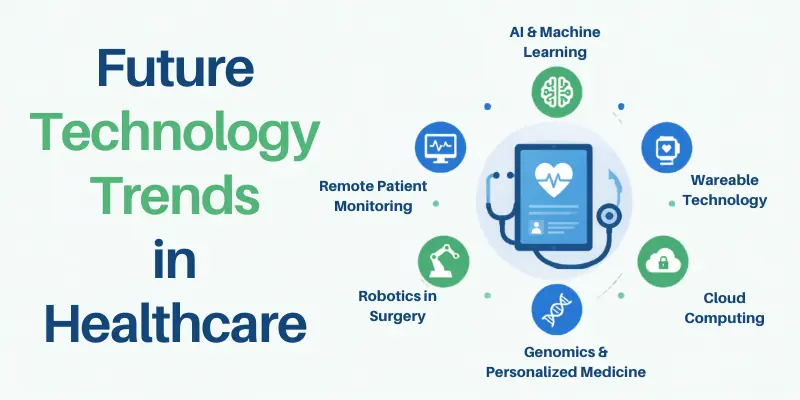
List of Future Healthcare Technology Trends:
- Artificial Intelligence in Diagnosis
- Telemedicine and Virtual Healthcare
- Wearable Health Monitoring Devices
- Robotic Surgery Systems
- Blockchain for Medical Records
- Internet of Medical Things (IoMT)
- Personalized Medicine
- 3D Printing in Healthcare
- Augmented Reality in Medical Training
- Big Data and Healthcare Analytics
- Smart Hospitals and Automation
- Gene Editing and CRISPR Technology
Let us cover all these trends in detail.
1. Artificial Intelligence in Diagnosis
Artificial intelligence is transforming medical diagnosis. AI systems can analyze large amounts of patient data in seconds and help doctors detect diseases earlier. These systems improve accuracy and reduce human errors in medical analysis. AI also helps doctors identify patterns in medical images and patient history. This shows how future healthcare technology is becoming smarter and more reliable.
Examples of AI tools in healthcare:
- AI medical imaging scanners
- AI-powered diagnostic software
- Disease prediction algorithms
- Clinical decision support systems
2. Telemedicine and Virtual Healthcare
Telemedicine allows patients to consult doctors remotely using digital platforms. This technology became very popular after the global pandemic. It saves time, reduces hospital visits, and allows patients in remote areas to receive proper care. Many healthcare providers are now investing in virtual clinics as part of the technology and the future of health care.
Common telemedicine solutions:
- Video consultation platforms
- Online patient portals
- Remote diagnosis apps
- Virtual healthcare platforms
3. Wearable Health Monitoring Devices
Wearable devices help people monitor their health in real time. These devices track heart rate, sleep patterns, physical activity, and other vital signs. Doctors can use this data to detect health problems early. As a result, wearable devices are becoming an important part of new technology in healthcare.
Popular wearable technologies:
- Smartwatches with health tracking
- Fitness monitoring bands
- Continuous glucose monitors
- Heart rate monitoring devices
4. Robotic Surgery Systems
Robotic surgery allows doctors to perform precise medical procedures with minimal errors. Surgeons control robotic arms that perform delicate operations with high accuracy. This technology helps reduce recovery time and surgical risks. Robotic systems are becoming a major part of innovation in hospitals.
Robotic surgery tools include:
- Da Vinci surgical system
- Robot-assisted laparoscopic tools
- Surgical navigation systems
- AI-assisted surgical robots

5. Blockchain for Medical Records
Blockchain technology helps protect patient data and improves medical record security. It creates a secure digital ledger where patient records cannot be easily altered. This technology allows hospitals and clinics to share data safely. Blockchain is becoming an important part of future technology health care systems.
Blockchain healthcare solutions:
- Secure patient record systems
- Medical data sharing platforms
- Digital health identity systems
- Blockchain-based insurance processing
6. Internet of Medical Things (IoMT)
The Internet of Medical Things connects medical devices through the internet. This allows doctors to monitor patients remotely and receive health data in real time. Hospitals can track equipment and improve operational efficiency. IoMT is a major step toward smarter healthcare systems.
Examples of IoMT devices:
- Smart patient monitoring systems
- Connected medical sensors
- Remote patient monitoring tools
- Smart hospital equipment

7. Personalized Medicine
Personalized medicine focuses on providing treatments based on an individual’s genetic profile. Doctors analyze a patient’s DNA to create customized treatment plans. This approach increases treatment effectiveness and reduces side effects. It represents the growing connection between biotechnology and health care in future.
Personalized medicine technologies:
- Genetic testing tools
- DNA sequencing systems
- Precision treatment platforms
- Genomic analysis software
8. 3D Printing in Healthcare
3D printing allows doctors to create customized medical devices and implants. Hospitals can print prosthetics, dental implants, and even tissue structures. This technology reduces production costs and improves patient comfort.
Applications of 3D printing:
- Custom prosthetics
- Dental implants
- Surgical models for training
- Tissue printing experiments
9. Augmented Reality in Medical Training
Augmented reality is improving medical education and training. Medical students can visualize organs, surgeries, and procedures in 3D environments. This technology helps doctors practice complex procedures before performing them on patients.
AR healthcare tools:
- AR surgery training systems
- Medical simulation platforms
- Anatomy visualization apps
- AR learning environments
10. Big Data and Healthcare Analytics
Healthcare organizations generate massive amounts of data every day. Big data tools and professional data analytics services help analyze this information to improve patient care and hospital management. These insights help doctors predict diseases and plan treatments. When integrated with hospital management software, healthcare providers can streamline administrative workflows, enhance data accessibility, and make more informed clinical decisions.
Healthcare analytics tools:
- Medical data analysis platforms
- Predictive health analytics systems
- Hospital performance dashboards
- Patient outcome tracking tools
11. Smart Hospitals and Automation
Smart hospitals use automation and digital systems to improve efficiency. Automated check-in systems, smart beds, and AI-based monitoring tools are becoming common. These innovations reduce hospital workload and improve patient experience.
Smart hospital technologies:
- Automated patient registration systems
- Smart hospital beds
- AI monitoring systems
- Hospital workflow automation tools
12. Gene Editing and CRISPR Technology
Gene editing allows scientists to modify DNA to treat genetic diseases. CRISPR technology can remove harmful genes and replace them with healthy ones. This breakthrough could help cure many inherited diseases in the future.
Gene editing technologies:
- CRISPR gene editing tools
- DNA modification platforms
- Genetic therapy research systems
- Molecular biology labs
How Healthcare Organizations Can Prepare for Future Technology
Healthcare organizations must adapt to modern technology to stay competitive. Hospitals need to invest in digital systems, training programs, and advanced medical tools. Preparing for technological change will help medical institutions improve services and patient outcomes.
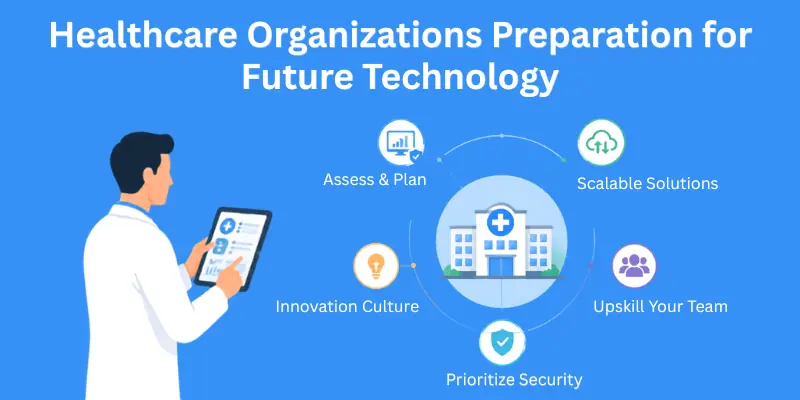
Some important strategies include:
- Invest in digital healthcare infrastructure
- Train medical staff on new technologies
- Implement secure data systems
- Use AI tools for patient analysis
- Adopt telemedicine platforms
- Upgrade hospital equipment with smart systems
These strategies help hospitals adopt technology and innovation in healthcare and prepare for the health care in future.
Conclusion
In this guide we have covered future technology trends in healthcare with great detail. These technologies show how digital tools, AI, robotics, and biotechnology are transforming modern medicine.
My personal recommendation is that healthcare professionals, hospitals, and medical students should stay updated with these innovations. The technology and the future of health care will continue to evolve quickly, and those who learn and adapt will benefit the most. These innovations will define the health of the future and improve patient care worldwide.
Thank you for reading this guide, and do not forget to check the FAQs below.
FAQs
Here are some of the most frequently asked questions related to future technology trends in healthcare:
Future technology trends in healthcare include artificial intelligence, telemedicine, wearable health devices, robotic surgery, and big data analytics. These technologies help doctors diagnose diseases faster and improve patient care. Hospitals also use digital systems to manage medical data and treatments.
Technology is important for the health care in future because it improves diagnosis, treatment accuracy, and hospital management. Digital health tools allow doctors to monitor patients remotely and provide faster care. As healthcare evolves, technology will make medical services more accessible.
Some examples of new technology in healthcare include AI-powered diagnostic tools, telemedicine platforms, wearable health trackers, robotic surgery systems, and digital health records. These technologies help doctors provide better and faster treatments.
Technology and innovation in healthcare improve patient care by allowing early disease detection and accurate diagnosis. Digital systems help doctors analyze medical data quickly and create better treatment plans. Patients also benefit from remote monitoring and online consultations.
Hospitals use modern technologies to support innovation in hospitals. They implement smart medical equipment, AI diagnostic tools, automated patient systems, and digital records. These solutions improve hospital efficiency and patient safety.
Artificial intelligence will be a major part of future healthcare technology. AI systems can analyze medical images, detect diseases early, and support doctors in making clinical decisions. This technology will also help hospitals manage patient data more efficiently.
Future technology health care refers to the use of advanced digital systems, automation, and smart medical devices in healthcare services. These technologies help doctors deliver faster treatments and improve patient outcomes.
The health of the future will be shaped by artificial intelligence, wearable health devices, gene editing, telemedicine, and data analytics. These technologies will allow doctors to detect diseases earlier and provide personalized treatments.
The technology and the future of health care are closely connected because medical services depend on digital innovation. Technologies like AI, robotics, and remote monitoring systems will improve healthcare quality and efficiency.
Healthcare organizations can prepare for future healthcare technology by investing in digital infrastructure, training medical staff, and adopting smart medical systems. Hospitals also need strong data security systems to protect patient information.
- ✔ Be Respectful
- ✔ Stay Relevant
- ✔ Stay Positive
- ✔ True Feedback
- ✔ Encourage Discussion
- ❌ Avoid Spamming
- ❌ No Fake News
- ❌ Don't Copy-Paste
- ❌ No Personal Attacks