
Increase Domain Rating (DR): Step-by-Step Guide
Hey there! Welcome to an exciting and myth-busting discussion about SEO and blogging! The Domain Rating (DR).... a metric everyone talks about but often misunderstands.
Let me clear the air first.
DR is NOT a direct Google ranking factor. It’s a metric developed by Ahrefs to measure the strength of a website’s backlink profile.
But here’s the catch: many beginners and even some experts fall into the trap of obsessing over DR instead of focusing on what really matters for SEO.
In this article, I’ll share legit tips to increase your DR, but first, here are some truths you need to know.
Step to Increase DR of Your Website
Guys, here comes the main topic of our discussion: “How to Increase Domain Rating of Website”. Here are all the authentic and organic easy mentioned:
- Build ‘Followed’ Backlinks
- Create Content That Attracts Natural Links
- Utilize Internal Linking Effectively
- Use a Balanced Anchor Text Strategy
- Disavow Spammy or Harmful Backlinks
- Optimize On-Page SEO
- Ensure Fast Loading Speed
- Make the Website Mobile-Friendly
- Promote Content to Reach a Wider Audience
Let us cover each in detail.
1. Build ‘Followed’ Backlinks
Followed backlinks are links from other websites that pass authority to your site.
Why It’s Important: Backlinks tell search engines that your website is valuable. The more quality links you have, the higher your DR.
Steps to Build Followed Backlinks:
- Create High-Quality Content: Write blog posts, guides, or tools that provide useful information others want to share.
- Reach Out to Relevant Websites: Identify sites in your industry and ask them to link to your content. Make sure they have a good DR themselves.
- Guest Posting: Offer to write articles for high-authority websites and include a link back to your site.
Pro Tip: Focus on websites with high DR that don’t link to too many external sites. Links from such sites are more valuable.
2. Create Content That Attracts Natural Links
Great content naturally earns backlinks over time. As mentioned above, content that is too helpful is a perfect strategy for increasing the DR.
What Makes Content Link-Worthy?
- Non-Commercial: Content should not feel like a sales pitch. For example, an article titled “10 Tips to Rank Website” is more likely to get links than a page selling black hat seo services.
- Helpful: Create content that solves problems or offers value.
- Citable: Share unique data, statistics, or ideas that others want to reference.
Example: Ahrefs’ backlink checker tool gained over 1,800 backlinks because it provides value to users and is free.
How to Find Link-Worthy Topics:
- Use keyword research tools to see what people search for.
- Check the top-ranking pages for your topic and see how many backlinks they have.
- Choose topics that consistently attract links and avoid outdated trends.
3. Use Internal Linking Effectively
Links from one page of your website to another. Link your new content to other relevant pages on your site to distribute authority and help search engines understand your site structure.
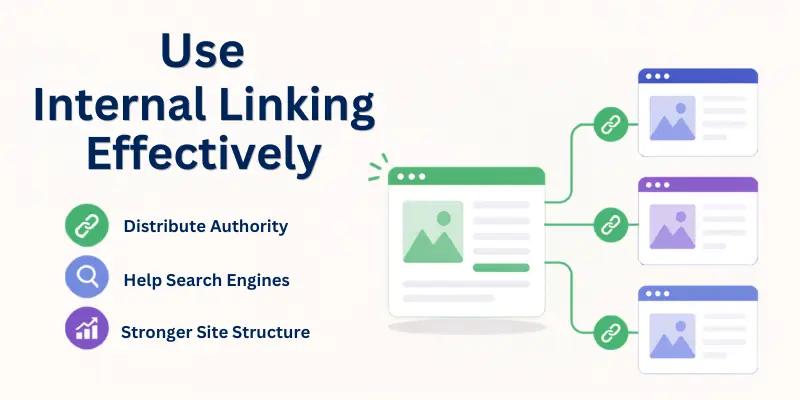
Why It Helps: They spread authority from high-ranking pages to others, helping search engines understand your site structure.
How to Use Internal Links:
- Add links to your most important pages, like service or product pages.
- Use descriptive anchor text (e.g., “SEO tips” instead of “click here”).
- Update old blog posts with links to newer content.
Example: A blog post about “What is Guest Blogging” can link to another post on “Guest Blogging Course”.
4. Use a Balanced Anchor Text Strategy
Anchor text is the clickable, often underlined, text in a hyperlink. It tells users and search engines what the linked page is about.
To make your backlink profile look natural and trustworthy to search engines, you should use a variety of anchor text types.
Here’s how to create balance:
1. Diversify Your Anchor Text:
- Use keyword-rich phrases that describe the linked content (e.g., "Best SEO tools").
- Include generic phrases like "Read more," "Visit this page," or "Learn more."
- Add brand name mentions (e.g., "Ahrefs").
- Incorporate naked URLs (e.g., "https://yourwebsite.com").
2. Match Anchor Text with Content: The anchor text should always relate to the page you’re linking to. Misleading links can confuse users and hurt your SEO.
3. Avoid Spammy Practices: Don’t overuse exact-match keywords. Avoid stuffing anchor text with repetitive or irrelevant terms.
4. Keep It Natural: Write links naturally within sentences. Forced links disrupt readability and may seem manipulative.
5. Disavow Spammy or Harmful Backlinks
Spammy backlinks are links from low-quality, irrelevant, or suspicious websites. These are often created through unethical practices, like automated bots or link farms.
SEO engines like Google penalize your website if they detect harmful backlinks. So, guys, you should disavow such spammy backlinks, which will automatically increase the DR of your site.
How to Remove Them:
- Use tools like Google Search Console or Ahrefs to identify harmful backlinks.
- Create a disavow file listing these links.
- Submit the file through Google’s Disavow Tool.

6. Optimize On-Page SEO
On-page SEO optimization doesn’t directly increase DR, but it improves search engine rankings, which can lead to more backlinks and higher authority for your site. Here is how you optimize on-page SEO factors:
- Use Keywords Naturally: Add relevant keywords to your content, but don’t overuse them.
- Optimize Meta Data: Write clear, descriptive titles with your main keyword. Create a brief description that summarizes the content.
- URLs: Keep URLs short, descriptive, and easy to understand. For example, instead of “example.com/blog123?id=45”, use “example.com/what-is-guest-blogging”. This is clearer for both search engines and users.
7. Ensure Fast Loading Speed
Fast-loading websites provide a better user experience, leading to higher engagement and more backlinks from authoritative sources. A slow website frustrates users and lowers rankings. So take care of such little things.
How to Improve Speed:
- Compress images to reduce file size.
- Use caching plugins to speed up page loading.
- Upgrade to a faster hosting service.
Why It’s Important: Google prioritizes websites that load quickly, especially on mobile devices.
8. Make Your Website Mobile-Friendly
Mobile optimization is crucial because Google prioritizes mobile-friendly websites in search rankings. And this increases your website’s authority and chances of earning valuable backlinks.
Websites that provide a good mobile experience are more likely to be linked to other websites, thus improving your DR.
Steps to Optimize for Mobile:
- Use a responsive design that adjusts to screen sizes.
- Ensure text is readable without zooming.
- Test your site on different devices.
9. Promote Content to Reach a Wider Audience
If your content is promoted and seen by more people (through social media, influencer outreach, or email), it has a higher chance of being linked to, thus increasing your DR.
How to Promote:
- Share posts on social media platforms like Facebook, LinkedIn, and Twitter (X).
- Email your audience with new content updates.
- Partner with influencers to share your content.
Artificial Ways to Boost DR
Some quick and easy ways to improve your website's Domain Rating (DR) may seem appealing, but they usually do more harm than good in the long run.
These spammy tactics are now very easy for Google and other search engines to spot. If you use them, you may get punished, which can damage your reputation and rankings.
- Paid-Link Schemes
- Link Exchanges
- Redirect Links
- Private Blog Networks (PBNs)
- Link Farms
- Spamming
- Link Manipulation
Let us look at the most common man-made ways to increase DR and what they do in detail.
1. Paid-Link Schemes
Paid link schemes are a way to enhance your website's presence by purchasing backlinks from various sites, often through link brokers. This approach helps you quickly build a diverse backlink profile.
Impact:
- Penalty Risk: Google prohibits buying or selling links for SEO. Detection of purchased backlinks can lead to penalties, including drops in rankings or removal from search results.
- Low-Quality Links: Paid links are often from low-quality sites or irrelevant sources, meaning they may not add much value to your site’s authority or even harm it.
- Temporary Gains: Even if you see a short-term boost in DR, the effects usually don’t last, and penalties can negatively impact your SEO.
2. Link Exchanges
Link exchanges are practices in which two websites agree to link to each other and artificially inflate their backlink profiles. This often involves reciprocal linking, where both sites benefit from each other's links.
Impact:
- Unnatural Link Profile: According to search engines, reciprocal linking is unnatural. However, it's not technically illegal because Google's algorithms are made to find link patterns that are used to trick people.
- Penalties: Too many link exchanges can result in penalties, making your website less visible in search results and negatively impacting your DR.
- Spammy Link Sources: Links from unrelated or irrelevant sites can harm your site's reputation. Link exchanges often fail to meet high-quality backlinks standards.
3. Redirect Links
Redirect links involve URL redirection methods (such as 301 or 302 redirects) to pass link equity from one domain or page to another. These redirects are often used to manipulate DR by directing search engines to treat redirected links as authentic backlinks.
Impact:
- Manipulated Link Equity: Redirecting links from irrelevant or spammy sources can create an unnatural backlink profile, which search engines can easily detect.
- Risk of Penalties: If Google detects that you are using redirects to manipulate rankings, you may be penalized, which can harm your overall SEO.
- User Confusion: Redirect links can create a poor user experience if visitors are sent to unexpected or irrelevant pages.
- Temporary Boost: Similar to other artificial methods, redirect links might offer a short-term increase in DR, but the long-term consequences outweigh any benefits.

4. Private Blog Networks (PBNs)
PBNs are networks of websites created specifically to build backlinks to a central website to artificially increase DR.
Most of the time, these sites are owned by the same person or group. They are used to trick search engines into giving them more weight by controlling many backlinks.
Impact:
- High Risk of Penalties: Google actively targets PBNs, and if your website is caught using them, you can face severe penalties or manual action.
- Poor Link Quality: The links from PBNs are usually not trustworthy or high-quality, which means they do little to improve your website’s authority.
- Long-Term Harm: While a PBN may seem effective in the short term, it is a high-risk strategy with a high probability of failure. The penalties can severely damage your site's DR.
5. Link Farms
A link farm is a group of websites created solely to link to other sites and manipulate search rankings. These sites are usually not very good and lack original content.
Impact:
- Google Penalties: Link farms are considered a form of spam by Google, and using them can result in penalties that harm your DR and SEO.
- Low-Quality Links: The backlinks generated from link farms are generally irrelevant and come from spammy sites. Google can easily detect these links.
- Reputation Damage: If users or search engines see your site linked to low-quality sites, it can damage your reputation, both in the eyes of Google and your visitors.
6. Spamming
Spamming refers to using unethical practices to gain backlinks, such as leaving comments on blogs, forum posts, or guestbook entries with a link to one's website without contributing valuable content or context.
Impact:
- Search Engine Penalties: Spamming violates Google’s guidelines and can result in penalties, significantly reducing your rankings and DR.
- Irrelevant Links: These spammy links usually come from irrelevant, low-quality sites and don't help your SEO efforts.
- User Experience Damage: If users see spammy links or feel like they are being manipulated, they are less likely to trust your website.
7. Link Manipulation
Link manipulation involves actively trying to manipulate or artificially control the way links are built to your website. This includes buying links, placing links on irrelevant websites, or using tools to manipulate the link graph.
Impact:
- Google Penalties: Google can detect unnatural link patterns, and link manipulation violates Google’s Webmaster Guidelines. Engaging in link manipulation can result in manual penalties.
- Risk to Reputation: If your link profile is manipulated, you risk being perceived as a manipulative or untrustworthy website.
- Loss of Trust: Links that you get by cheating don't really improve the content or authority of your site. As a result, your site may struggle to rank well even if your DR increases temporarily.
What Factors Do Ahrefs Use to Calculate DR?
Ahrefs uses four main factors to calculate the DR of your site:
1. Referring Domains
- The number of websites linking to your site matters.
- More links from different websites mean a higher DR.
- Each website linking to you is called a "referring domain."
2. Quality of Referring Domains
- The quality of the websites linking to you is very important.
- If high-authority and trusted sites link to you, your DR increases more.
- Links from low-quality or spammy sites don’t help as much.
3. Link Distribution
- Links from websites that don’t link to many other sites are more valuable.
- If a website links to only a few sites and includes your site, it boosts your DR more.
- Too many links on a single site reduce the value of each link.
4. Nofollow Links
- “Nofollow” links don’t pass authority.
- If a website marks a link as “nofollow,” it won’t help your DR.
- Focus on getting “do follow” links to improve your score.
Truths About DR You Must Understand
Keep these things in your mind:
1. It Takes Time and Effort
Building genuine domain authority requires years of hard work, creating quality content, and gaining trust in your niche. Reaching a DR of 80 in just one month is impossible. With consistent effort, you might achieve it in four years or more.
2. Beware of Scammers
Some people on Fiverr or other freelancing platforms promise to boost your DR with shady tricks. They exploit flaws in Ahrefs’ metrics, often by creating redirect notices. However, this can only puff up your DR to a maximum of 54—and it’s completely fake.
3. SEO is About More Than Just DR
Focusing only on DR or Domain Authority (DA) is a mistake. SEO success depends on 200+ ranking factors like great content, user experience, mobile optimization, technical optimization, and more.
Is DR a Direct Ranking Factor by Google?
No, Domain Rating (DR) is not a direct ranking factor for Google.
DR is a metric created by Ahrefs to measure the strength of a website based on the number and quality of backlinks it has. While DR is useful for understanding a site’s authority, Google doesn’t use DR directly to rank websites.
However, there are some indirect ways DR can impact your rankings:
- Backlink Quality and Quantity: Since DR is related to the quality and number of backlinks, websites with a higher DR tend to have better backlinks, which can help improve rankings on Google.
- Trustworthiness: A higher DR can signal to Google that your site is more trustworthy and authoritative, which could improve your visibility in search results.
- Content and User Experience: At the end of the day, Google ranks websites based on factors like content quality and how well users experience your site. While a higher DR can bring in valuable backlinks, it’s your content and user experience that really count for rankings.
So, while DR is not a direct ranking factor for Google, it can still play a role in improving your site’s SEO by helping you get better backlinks. Just remember, it’s not the only thing that matters—great content and a good user experience are key!
End Note
So, guys, it’s time to say goodbye. One thing I need to mention here is that you can use organic methods to increase the DR of your site, but always try to avoid spammy, artificial techniques.
Never, ever use services that promise to boost your DR quickly—they can completely damage your site’s ranking, and you will face significant losses in terms of authority and rankings.
Remember, SEO and organic techniques take time. The one who stays persistent and follows the right path will ultimately win the game. So, if you want to shine brightly and permanently, always stick to trustworthy techniques.
FAQs
Here are some of the most frequently asked questions related to DR boosting:
Not at all! Paid links can quickly boost DR, but they are risky. Google might penalize your site for buying links. It's safer to focus on organic link-building techniques rather than such fishy tricks.
Spammy backlinks usually come from low-quality or irrelevant websites. They might have unnatural anchor text or come from link farms. Always check the quality of the site before accepting backlinks.
Manipulating anchor text can seem tempting, but it’s not recommended. Google prefers natural anchor text. Over-optimized anchor text can trigger penalties.
The number of backlinks matters less than the quality of the sites linking to you. Focus on getting backlinks from authoritative, relevant websites instead of just getting a large number of links.
Spammy techniques, like leaving comments with links or using fake backlinks, can hurt your DR. Always use ethical, organic methods like content marketing and guest posts to build backlinks.
Never! Duplicate content can harm your site’s reputation and DR. Google doesn’t reward sites with copied content. Always create original, valuable content that adds value for users.
- ✔ Be Respectful
- ✔ Stay Relevant
- ✔ Stay Positive
- ✔ True Feedback
- ✔ Encourage Discussion
- ❌ Avoid Spamming
- ❌ No Fake News
- ❌ Don't Copy-Paste
- ❌ No Personal Attacks