
7 Quantum-Safe Encryption Services Evaluation: Picks for Robust Data Protection
Quantum computing is no longer just a future idea. It is becoming a real technology that can break many traditional encryption methods like RSA and ECC. Because of this risk, NIST plans to phase out these algorithms by 2030 and completely ban them by 2035. This means organizations have only a short time to upgrade their security systems.
In this 7 Quantum-Safe Encryption Services Evaluation, we will explore trusted services that help businesses protect their data now and stay prepared for the quantum era.
How Did We Select the 7 Quantum-Safe Encryption Services?
We did more than skim press releases. We studied the latest NIST drafts, ETSI working papers, and vendor audit reports, and we interviewed security architects already piloting post-quantum rollouts. In short, we distilled a roomful of research into guidance you can act on.
From that work, we scored each service against six pillars that separate marketing gloss from real protection:
- Cryptographic strength and alignment with NIST finalist algorithms
- Integration effort and practical crypto-agility
- Performance overhead in real traffic, not lab demos
- Vendor maturity and depth of ongoing support
- Regulatory fit and long-term durability
- Total cost of ownership, including hidden professional-services hours
Only tools that balanced all six pillars made the list. That is why you will not see every hype-driven startup here and why we still include proven players like Entrust. Seven services give you enough variety to compare real options without turning this guide into a phone book.
7 Quantum-Safe Encryption Services Evaluation
Below are seven services that offer different ways to implement quantum-safe security. The seven services include:
- Project 11
- Kyndryl
- Entrust
- Fortinet
- Google Cloud
- PKWARE
- QuSecure
Let me guide you about them in detail.
1) Project 11
Picture a thief who needs only your public Bitcoin address to empty it once a quantum computer comes online. Project 11 aims to close that window today.
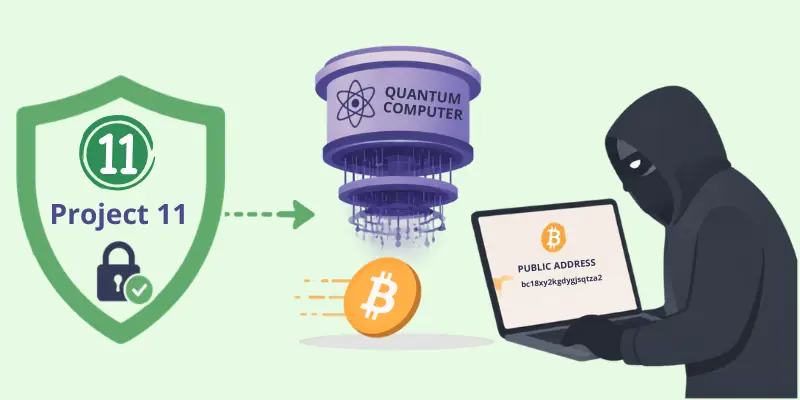
The startup’s open-source Yellowpages registry lets you create a fresh post-quantum key pair, then publish a cryptographic proof that links it to your existing address. The proof is timestamped on an off-chain ledger, so you keep full compatibility with the Bitcoin network and pay zero gas. No forks, no frantic wallet migrations, and a quiet layer of quantum insurance you can turn on over coffee.
Project 11 Yellowpages registry website screenshot for quantum-safe crypto wallets
What we like most is the low friction. Anyone, from a single HODLer to an institutional custodian, can generate keys, post the proof, and walk away with verifiable, quantum-resistant ownership. The service is free, publicly audited, and funded well enough to stay online, which removes the last excuses for procrastination.
There is a trade-off. Project 11 protects only assets that live on blockchains using elliptic-curve cryptography. If your bigger headache is enterprise data or SaaS secrets, you will need one of the broader solutions that follow. Still, for crypto portfolios worth real money, Yellowpages is the simplest first step you can take before the quantum wave hits.
2) Kyndryl
Before you swap a single key, you need a map. Kyndryl’s Quantum-Safe Assessment gives you one that is painfully detailed and refreshingly actionable.
Consultants sift through every application, appliance, and third-party service you run, then assemble a cryptographic bill of materials. Nothing hides. An old TLS library in a forgotten microservice? It goes on the list. A backup system still relying on thirty-year-old RSA? Flagged, scored, and scheduled for retirement.
With that inventory in hand, Kyndryl ranks each item by business criticality and quantum exposure. The result is a phased roadmap that hits high-risk assets first, aligns with the Zero Trust policies you already follow, and slots neatly into upcoming mandates like NSA’s CNSA 2.0.
Yes, it is a paid engagement, and you still have to execute the plan Kyndryl hands you. But if you run a sprawling estate of mainframes, clouds, and SaaS, skipping discovery is how you end up bolting post-quantum controls on rather than building them in. This assessment prevents that mistake.

3) Entrust
Sending a quantum-safe message is pointless if the certificate that proves your identity breaks the moment Shor’s algorithm runs. Entrust fortifies those roots of trust, modernizing everything from public-key infrastructure to the hardware modules that guard your keys.
Its Quantum Java Toolkit lets developers create hybrid certificates that pair today’s RSA with tomorrow’s lattice algorithms. Existing smart cards, VPN concentrators, and IoT devices still recognize the classical half, while the post-quantum half waits for the future. Firmware updates for Entrust HSMs let you store the larger key sizes used by Kyber and Dilithium.
The reward is continuity. You replace fragile links without tearing out the entire PKI, and you preserve the audit trails, revocation workflows, and compliance artifacts your auditors already understand. The caveat is timing: many features are in controlled release, so you will test them first before promoting them to production. That patience pays off if your business relies on signed transactions and device identities.
4) Fortinet
If your sites already route traffic through a FortiGate, you are one firmware update away from quantum-safe tunnels. FortiOS 7.6 adds a hybrid key-exchange option to IPsec VPNs: classic Diffie–Hellman pairs with Kyber, forcing an attacker to break two locks instead of one. Toggle the setting, push policy, and every packet between offices gains encryption that survives the quantum shift.
Fortinet FortiGate firewall hybrid IPsec VPN quantum-safe configuration screenshot
Performance worries? Field pilots show CPU increases of only a few percentage points and no measurable drop in throughput. Fortinet also provides training modules so network teams know what the new mode does, not just which box to tick.
Scope remains the caveat. Fortinet protects data in transit, not databases or backups. Still, it is the quickest visible win on any quantum-migration checklist.

5) Google Cloud
Google has added post-quantum algorithms to Cloud KMS, so you can call an API and receive a Kyber-protected key without reading crypto theory. From that moment, every object in Cloud Storage inherits quantum-safe encryption, and any service that signs data can shift to Dilithium with a single flag.
Google Cloud KMS post-quantum key management console screenshot
Speed is the appeal. Google owns the key material, rotates it on schedule, and will replace algorithms the minute NIST finalizes new guidance, while you keep releasing features.
Limits remain. You need to run, or at least back up, in Google Cloud, and regulated industries must wait for the new modes to clear FIPS validation. For cloud-first teams, though, turning on quantum safety is a checkbox, not a project.
6) PKWARE
Encrypting a file is simple; keeping it encrypted as it moves from laptop to SharePoint to long-term archive is the hard part. PKWARE tackles that gap with PK Protect, a suite that scans every corner of your estate, classifies sensitive content, and automatically re-wraps it in post-quantum security wherever it lands.
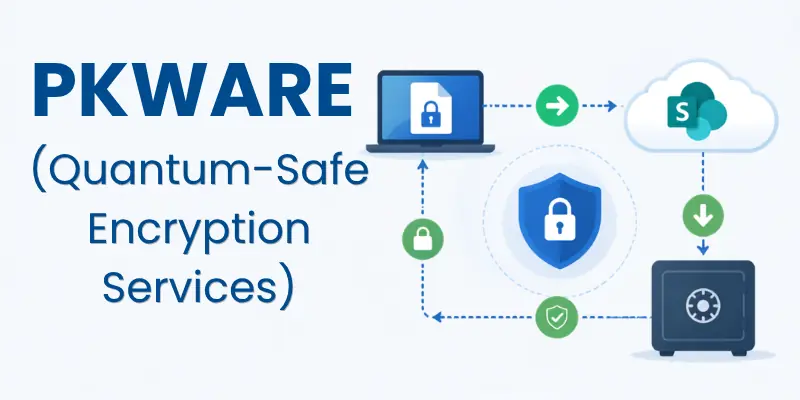
Run the Quantum Readiness Assessment and you receive a heat map of high-value data, plus a switch-by-switch migration plan. Flip on the new quantum-safe policy and the software applies lattice-based encryption to files, databases, and backups, in flight and at rest. Governance teams appreciate the audit trails, and admins like that no application code breaks.
You do stay inside PKWARE’s ecosystem for key management and decryption, so budget for licenses across every environment that touches regulated data. The result is consistency: once a record is protected, it stays protected from endpoint to cloud, and back again.
7) QuSecure
QuSecure takes a different approach: instead of selling components, it offers an overlay service that sits between your network and the outside world. Route traffic, keys, and IoT device enrollments through QuProtect, and the platform wraps every session, file, and signature in post-quantum algorithms.
QuSecure QuProtect quantum-safe overlay security platform homepage screenshot
Because it is SaaS, you receive continuous updates. When NIST selects a new algorithm or retires one, QuSecure updates the back end and your environment inherits the change overnight. No hardware swaps and no code recompiles.
Breadth is the draw. A single dashboard shows quantum-safe VPNs, certificate orchestration, and key management across on-prem, cloud, and remote workers. The trade-off is dependency: you rely on a young vendor as the cryptographic middleman for everything you do, and subscription fees rise with traffic. For organizations without a team of crypto engineers, that bargain often feels reasonable.
A Quick Side-by-Side Snapshot
We have covered a lot of ground, so let us set the seven picks next to each other for a moment. The table below distills what matters: what each service does, where it plugs in, the strongest reason to adopt it, and the biggest caveat to keep in mind.
Scan it, mark the columns that match your pain points, then jump back to the deeper dives as needed.
|
Service |
Core focus |
Integration style |
Stand-out strength |
Primary limitation |
|
Project 11 |
Blockchain key protection |
Off-chain registry plus proof |
Zero cost, no protocol change |
Only guards crypto assets |
|
Kyndryl |
Enterprise assessment |
Consulting engagement |
Full cryptographic inventory |
High price, you must execute |
|
Entrust |
PKI & HSM upgrade |
Toolkits, hybrid certs, firmware |
Modernizes roots of trust without a rip-and-replace |
Some features still in beta |
|
Fortinet |
Network encryption |
Firmware update to firewalls |
Instant PQ VPNs, negligible performance hit |
Covers data in transit only |
|
Google Cloud |
Cloud key management |
API toggle in KMS |
Quantum-safe keys at cloud scale |
Tied to Google ecosystem |
|
PKWARE |
Data-centric encryption |
Agent and policy engine |
Protection follows the file everywhere |
Requires full-suite licensing |
|
QuSecure |
Managed overlay |
SaaS gateway and agents |
One dashboard for all crypto layers |
Vendor lock-in, and fees scale |
Remember, the goal is not to crown a universal winner. It is to spot the service that plugs the biggest hole in your environment first, then layer others as your roadmap matures.
Conclusion
In this blog post, we have covered quantum safe encryption services evaluation in great detail and explored seven powerful services that help organizations prepare for the coming quantum era. Each platform offers a different approach, from protecting crypto wallets and VPN connections to managing enterprise encryption and cloud security.
In my view, businesses should start with solutions that match their current infrastructure, for example, Fortinet for network protection, Google Cloud for cloud environments, or PKWARE for data protection across systems. The most important step is to begin planning now rather than waiting until quantum threats become real.
If you want to learn more about modern security tools, technology insights, and practical guides, feel free to explore more articles and resources on our website.
FAQs
Here are some of the most frequently asked questions related to quantum safe encryption services evaluation:
Quantum-safe encryption is a modern security method designed to protect data from future quantum computer attacks. Traditional encryption may become weak when powerful quantum computers arrive. Businesses now adopt stronger algorithms to stay secure. This approach improves long-term data security for sensitive information.
Modern encryption services protect files, messages, and databases by converting them into unreadable code. Only authorized users with the correct keys can access the data. This process helps organizations maintain strong data protection for customer and company information. Many businesses now rely on cloud-based secure data services to manage this protection easily.
Quantum encryption uses advanced cryptographic methods designed to resist attacks from quantum computers. Traditional encryption relies on algorithms like RSA that may become vulnerable in the future. New encryption methods focus on stronger mathematical structures. These innovations represent the next generation of encryption technology.
Quantum cryptography uses advanced mathematical and physical principles to secure digital communication. It helps prevent attackers from breaking encryption keys even with powerful computing systems. Organizations use it to protect sensitive systems and confidential data. This improves overall information security across networks and platforms.
Encryption tools are software or platforms that help users protect digital information. They can encrypt emails, files, databases, and communication channels. Businesses use these tools to secure systems and prevent unauthorized access. Many companies also use them to enable secure communication between teams and partners.
Strong encryption protects personal and business data from hackers and unauthorized users. It ensures that private information remains confidential during storage and transfer. Organizations that invest in security technologies improve customer trust and compliance. This helps protect overall data privacy in digital environments.
Yes, many companies now offer early quantum-safe encryption solutions. These services help businesses prepare before quantum computers become powerful enough to break current encryption. Many cloud providers and cybersecurity firms already test and deploy these technologies. This early adoption strengthens long-term data protection strategies.
Any organization that stores sensitive data should consider upgrading to quantum-safe security. Banks, healthcare companies, government agencies, and tech firms especially benefit from these solutions. They protect critical information and digital assets from future cyber threats. Investing in advanced encryption today helps ensure stronger data security in the future.
- ✔ Be Respectful
- ✔ Stay Relevant
- ✔ Stay Positive
- ✔ True Feedback
- ✔ Encourage Discussion
- ❌ Avoid Spamming
- ❌ No Fake News
- ❌ Don't Copy-Paste
- ❌ No Personal Attacks