
What Is Domain Authority (DA) & Why Does It Matter?
Have you ever come across the term "DA" in SEO and wondered what it actually means? You’re not alone!
Many website owners and seo experts are confused about how Domain Authority works and why it's important for improving rankings. In this article, we'll explain what is DA (Domain Authority) in SEO, how it is calculated, and how it affects your site.
Let’s get started!
What is DA in SEO?
Domain Authority, or DA, is a number that tells search engines how strong a website is. This score was made by Moz, a company known for its SEO tools.
Domain Authority (DA) is a way to predict a website's performance in search engine results. It checks the strength of a website's domain as a whole. The DA score ranges from 1 to 100. A higher score means a better chance of ranking well in search results.
Well, this is different from Page Authority, which focuses on the ranking ability of a single page.
How Is Domain Authority Calculated?
Domain Authority (DA) measures how likely a website is to rank on Google compared to others. It uses factors like the number of unique websites linking to you and the total number of backlinks. A machine learning algorithm predicts how often your site appears in search results.
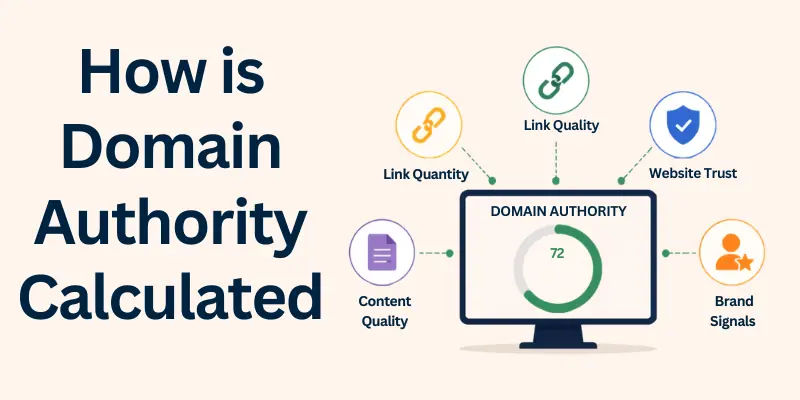
Websites with more unique links and stronger backlink profiles get higher DA scores. Since the system updates as new data comes in, your DA score can change. For example, if a big website like Facebook gets a lot of new links, smaller websites may see their DA scores drop slightly.
It’s easier to grow your DA from 20 to 30 than from 70 to 80 because higher scores are harder to achieve. Remember, DA is not part of Google’s ranking system—it’s a tool to compare your website’s strength with others.
What Factors Influence Domain Authority?
Two main factors influence the DA:
1. Linking Root Domains
These are the number of unique websites that link to your site. For example, if 50 different websites each link to your site once, you have 50 linking root domains.
Why It Matters: More unique websites linking to your site show search engines that your content is trusted and valuable. This can boost your Domain Authority.
2. Total Number of Backlinks
Backlinks are all the links pointing to your website from other sites. Unlike linking root domains, this counts every link, even if multiple come from the same site.
Why It Matters: A high number of backlinks indicates popularity and relevance. However, quality matters more than quantity; spammy links can hurt your score.
Why is Domain Authority Important in SEO?
DA plays a significant role in understanding a website's ability to rank in search engines. Here’s why it matters:
1. Comparative Analysis
DA helps you compare your website with competitors. A higher DA often indicates a stronger website that is more likely to rank higher in search engine results.
2. Link-Building Strategy
Websites with high DA are more trusted by search engines. Targeting backlinks from such sites can boost your website’s credibility and ranking potential.
3. Performance Tracking
DA acts as a helpful metric to monitor your website’s growth over time. If your DA increases, it often reflects an improvement in your site’s backlink profile and SEO strategy.
4. Ranking Strength Indicator
While not a direct Google ranking factor, DA provides insights into your website's strength in terms of authority and relevance in your niche. This helps you set realistic goals for content and link-building efforts.

How to Check Your Domain Authority?
You can check and track your Domain Authority (DA) easily using Moz’s tools. Here’s how:
1. Use Moz’s Link Explorer
Go to Moz Link Explorer and enter your website’s URL. If you don’t have an account, create a free Moz Community account to access up to 10 searches per month. Link Explorer provides essential metrics like Domain Authority, Page Authority, and the number of linking domains.
2. Use MozBar
Download MozBar, a free SEO toolbar for your browser. While surfing, you can view your website's DA, the number of backlinks, and linking root domains directly on the toolbar.
3. Monitor Through Moz Pro
Moz Pro includes DA metrics in its campaigns. You can use this to track performance over time, view backlink data, and analyze competitors.
4. Bulk Domain Authority Checks
For managing multiple websites, use the Moz API. This tool allows bulk access to DA metrics, backlinks, and other link data, making it ideal for businesses and SEO professionals.
What Is a Good DA Score?
A "good" Domain Authority (DA) score depends on your specific goals, competitors, and niche. Here's what you need to know:
- No Universal Good Score: There’s no fixed number that defines a "good" DA. It’s all about context and competition.
- Starting Point: New websites begin with a DA score of 1 and grow as they gain quality backlinks over time.
- Relative Scoring: Compare your DA to your competitors. A "good" score is one that is higher than those of your direct competitors in search results.
- Impact of Backlinks: Websites with many high-quality backlinks often have higher DA scores, while small or less-linked sites may have lower scores.
- Competitive Landscape: Compare your site to others in the same niche or industry using DA as a measure.

Common Misconceptions About Domain Authority
There are several myths about Domain Authority (DA) that can cause confusion. Here’s what you should know to avoid common misunderstandings:
- DA Is Not a Google Ranking Factor: Many people think DA directly affects Google rankings, but this isn’t true. Moz created DA to estimate how well a site might rank—it’s not used by Google.
- DA Isn’t the Only Metric That Matters: While DA is useful, it does not tell the full story. Other metrics, such as Page Authority, Domain Rating, and keyword rankings, are also important. Depending solely on DA can lead to an incomplete view of your site’s performance.
- DA Scores Can Change: Some believe DA is static, but it’s actually a dynamic metric. It shifts over time based on updates to your backlinks and content quality.
- DA Is Not the Same as PageRank: DA and PageRank are often mixed up, but they’re different. Both measure authority, but they use separate methods and data sources. Knowing the distinction helps you better analyze your site.
Using Domain Authority in Your SEO Strategy
You can make Domain Authority a helpful tool in your SEO plan.
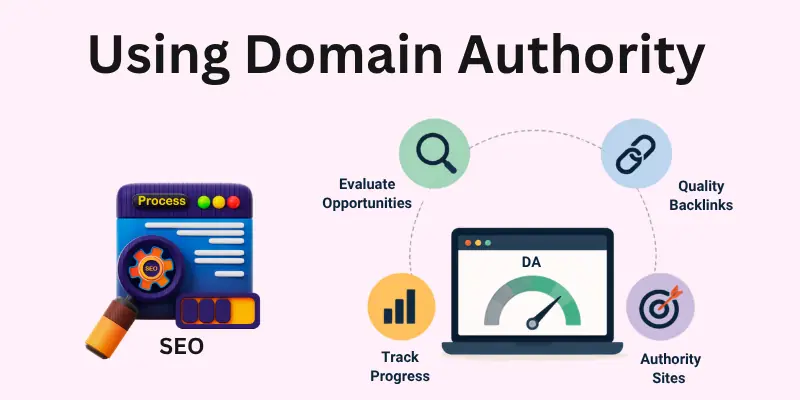
Here’s how to use it effectively:
- Monitor Your DA Score Regularly: Track changes in your DA over time. An increase in DA suggests your SEO efforts are working, while a drop may indicate areas to improve.
- Compare DA with Competitors: Look at your competitors’ DA scores. A higher DA score compared to theirs gives you an advantage. If your DA is lower, identify opportunities to strengthen your site’s authority.
- Focus on High-Quality Backlinks: Use DA to prioritize which websites you want backlinks from. Target authoritative sites, as these links have a more significant impact on your DA.
- Assess Content Quality: Make sure that your content meets the needs of your audience. More visitors and links come to sites with good content, which raises both their domain authority (DA) and search rankings.
Why Does Domain Authority Change?
Domain Authority changes due to various factors, making it a dynamic score. Here’s why your DA might fluctuate:
- Backlink Growth: New backlinks may not yet appear in Moz’s index.
- Scaling Process: The sites with the highest authority may gain links, changing the overall scale.
- Quality of Links: Some links may not contribute to rankings, affecting your DA.
- Crawling Variations: Moz may crawl more or fewer linking domains during updates.
- Relative Nature of DA: DA is a comparative score, so changes in other sites' performance can influence yours.
Understanding these reasons helps you interpret your DA score accurately and plan improvements.
What Is the Difference Between DA and PA?
Guys, as you know (DA) measures an entire website or subdomain's overall strength and ranking potential, as I have learned above.
On the other hand, Page Authority (PA) focuses on individual pages of your website. It evaluates how well a specific page can rank on search engines based on factors like backlinks to that particular page, content quality, and SEO optimizations.
Key Differences:
- Scope: DA evaluates the authority of the entire site, while PA is concerned with the strength of individual pages.
- Usage: DA is useful for comparing different websites, whereas PA is used to assess how well a specific page might perform in search engine results.
- Factors: DA is influenced by the backlinks and authority of the entire website, whereas the backlinks and content of an individual page determine PA.
In simple terms, DA shows how strong your entire website is in rankings, and PA shows how strong specific pages on your site are for ranking.
Conclusion
In this article, we have covered “What is DA (Domain Authority)” in detail. As we know, these are the third-party tools used to predict different SEO factors.
Guys, you should never solely rely on these tools; just use them professionally by taking any idea of how strong the site is or not, but do not just solely rely on these factors that you forget the main goal of your site, which is to rank the site and get organic traffic to it.
So, loved ones, if you are still confused about the domain authority factor, please comment below, and we will help you.
FAQs
Here are some of the most frequently asked questions related to DA (Domain Authority).
"Domain Authority" is what "DA" stands for in SEO. Moz created a search engine ranking score that tells you how likely a website will show up on search engine result pages (SERPs).
Well, there is no direct answer to this. Because Google did not introduce this factor, we can't say whether this specific number is good, as sites with low DA can also compete with high DA sites. Just look up these, but do not rely on them.
There are three types of Authority scores introduced by Moz:
- Page Authority
- Domain Authority
- Brand Authority
To boost your Domain Authority, prioritize overall SEO by creating high-quality content, gaining authoritative backlinks, and providing a positive user experience.
Both DR and DA are based on how strong a website's backlink profile is, but DA is a parameter introduced by Moz, and DR (Domain Rating) is a parameter introduced by Ahrefs. DA looks at more things, such as MozRank, MozTrust, and the website's link profile, while DR focuses more on the number and quality of backlinks.
A spam score in SEO indicates the risk of a site being penalized due to spammy practices. A high score signals potential issues, such as bad backlinks. To keep it low, follow ethical SEO and ensure quality content.
Linking root domains are unique websites that link to you and greatly affect Domain Authority. More links from trusted sites mean higher DA, while fewer links can lower it. Create valuable content and use link-building strategies to increase these links.
- ✔ Be Respectful
- ✔ Stay Relevant
- ✔ Stay Positive
- ✔ True Feedback
- ✔ Encourage Discussion
- ❌ Avoid Spamming
- ❌ No Fake News
- ❌ Don't Copy-Paste
- ❌ No Personal Attacks