
What is DR & How It Is Calculated?
Did you know that Domain Rating (DR) is a metric created by Ahrefs to measure how strong a website’s backlinks are?
Backlinks, or links from other websites pointing to yours, are important for SEO. DR uses these links to give a score that shows the “authority” of a website.
While Domain Rating (DR) isn’t a direct ranking factor used by Google, many SEO experts regard it as a strong indicator of a website’s ranking potential.
In this article, we will explore what is DR, how it functions, and its importance in enhancing your site’s organic traffic.
What is Domain Rating in SEO?
Domain Rating (DR) is a number created by Ahrefs to show how strong a website’s backlinks are. Backlinks are links from other websites to yours. The DR score ranges from 0 to 100, with higher numbers meaning the website has stronger backlinks and more authority.
DR helps you see how likely a website will get traffic from Google based on its backlinks. Unlike other scores focusing on a single page, DR looks at the entire website. It’s a helpful tool in SEO to compare websites and find opportunities to build more links to improve rankings on search engines.
How Domain Rating Works & Is Calculated?
As I have already mentioned, DR is a number from 0 to 100 given to a website by Ahrefs. It shows how strong the website’s backlinks are. The higher the score, the higher the site’s authority.
Ahrefs uses several factors to influence DR:
- Referring Domains: The more websites that link to you, the higher your DR tends to be.
- Quality of Referring Domains: If strong, trusted websites link to you, your DR will improve more.
- Link Distribution: Links from websites that link to fewer other sites are more valuable for boosting your DR.
- Nofollow Links: Links marked as “nofollow” do not contribute to DR.
Remember: “Ahrefs uses a special algorithm to calculate DR, but the exact formula is not shared”.
The score is based on how many backlinks you have, the strength of the referring sites, and the quality of those backlinks.
DR works on a logarithmic scale, which means the difference between a DR of 75 and 76 is much larger than between 20 and 21. As your DR increases, it becomes harder to improve it even more.

Why Domain Rating (DR) Matter?
In the SEO community, DR is widely used to:
Find Link-building Opportunities: DR helps you find websites with strong backlinks. You can create backlinks to target these sites and improve your site's authority.
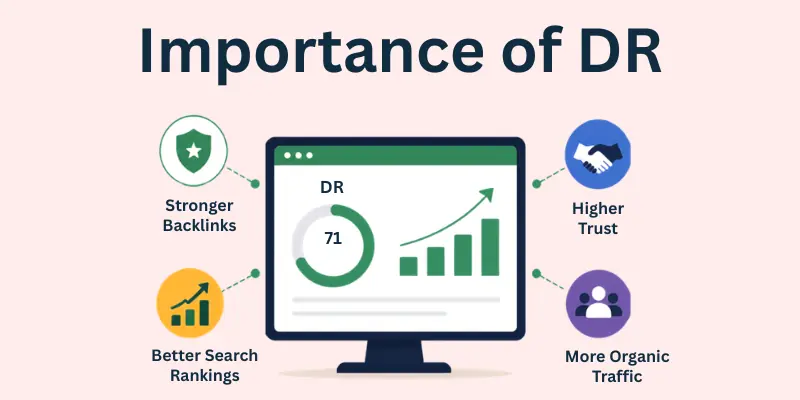
Estimate Ranking Potential: A higher Domain Rating (DR) means a website is more likely to rank for more keywords and attract organic traffic from search engines like Google. Therefore, DR is a useful indicator of a website's performance in search results.
Compare Backlink Strength: DR helps you compare the backlink profiles of different websites. You can see which websites have stronger or weaker backlinks. This helps you to understand the competition in your niche, too.
Domain Rating Factors
Domain Rating (DR) is influenced by many factors that can either help improve it or cause it to drop.
Positive Factors
These actions can help improve your DR:
- High-Quality Backlinks: More backlinks, especially from trusted websites, increase DR.
- Relevance: Links from websites related to your niche are more valuable.
- Unique Linking Domains: More unique sites linking to you show a wider reach.
- Anchor Text Diversity: Using different, relevant keywords in links helps DR.
- Internal Linking: A well-organized internal link structure improves DR.
- Website Age: Older sites often have better backlinks and higher DR.
Negative Factors
These actions can harm your DR:
- Low-Quality Backlinks: Links from spammy or low-quality sites hurt DR.
- Paid Links: Buying or selling links can lower DR.
- Unnatural Link Growth: Sudden spikes in backlinks can harm DR.
- Penalties: Violating search engine rules can lead to a lower DR.
- Hacked Sites: Malicious backlinks from a hacked site can damage DR.
- Thin Content: Poor-quality content attracts fewer valuable backlinks, lowering DR.
Benefits of a High Domain Rating (DR)
Here are the key benefits of having a high DR:
- Better Search Rankings: A high DR helps your website rank higher in search results for important keywords.
- More Organic Traffic: A higher DR means your site can rank for more keywords, bringing in more visitors from Google.
- More Trust and Credibility: A high DR makes your site look more trustworthy, which boosts its reputation.
- More Link-Building Opportunities: Sites with high DR are more likely to get high-quality backlinks from other respected websites.
- Stronger Competitiveness: With a high DR, your website can beat competitors and stay ahead in search rankings.
- Better Partnerships: Websites with high DR are more likely to attract business opportunities, partnerships, and collaborations.
Myths About Domain Rating
Here are some common myths about Domain Rating (DR):
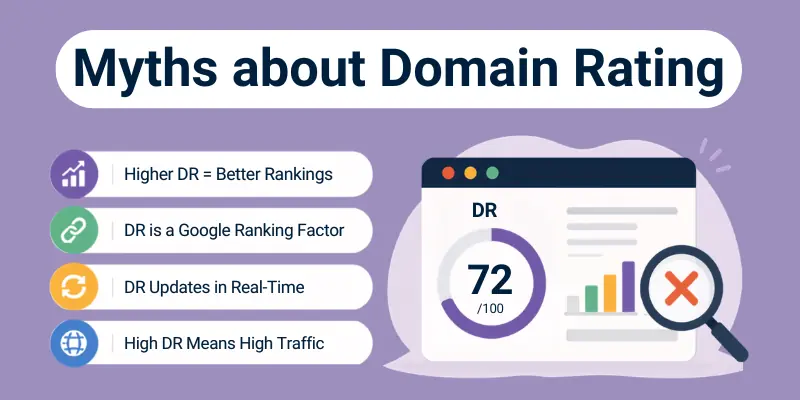
Myth 1: Higher DR Guarantees Higher Rankings
Reality: While DR is a valuable indicator, it's not a direct ranking factor for search engines. To determine rankings, Google uses hundreds of signals, including content quality, user experience, and technical SEO.
Myth 2: DR is the Only Metric That Matters
Reality: DR isn't the whole picture. If you only focus on DR, you will neglect other important SEO factors, like ensuring high-quality content and a great user experience.
Myth 3: DR is a Static Value
Reality: DR is not fixed. It can fluctuate based on changes in your backlink profile, website updates, and search engine algorithm updates.
Myth 4: DR Applies Universally
Reality: DR is specific to Ahrefs. Other SEO tools may use different metrics to assess website authority.
Myth 5: High DR Means Instant Success
Reality: A high DR doesn't guarantee instant success or rankings. Getting the most out of a strong DR takes time, work, and consistent optimization.

How to Check DR with Ahrefs?
Here is how you can check the domain rating in both free and paid ways:
1. Free Method (Limited Data)
Go to the Ahrefs Website Authority Checker: Open your web browser and navigate to: https://ahrefs.com/website-authority-checker
Enter Your Domain: In the search bar, type the full URL of the website you want to check (e.g., www.example.com).
Click "Check Authority": Click the "Check Authority" button.
View Results: The tool will analyze your website and display limited information, including:
- Domain Rating
- Backlinks
- Linking Websites
2. Paid Method (Full Access)
Log in to Your Ahrefs Account: If you have an Ahrefs subscription, log in to your account.
Go to Site Explorer: Navigate to the "Site Explorer" tool within your Ahrefs account.
Enter Your Domain: In the search bar, type the full URL of the website you want to check and click "Search."
Find Domain Rating (DR): The Domain Rating (DR) score is prominently displayed on the "Overview" page. It's usually located near the top of the page, often alongside other key metrics like Referring Domains and Organic Traffic.
Conclusion
So, guys, it's time to wrap up. In this article, we’ve covered Domain Rating (DR) in detail.
Here's my advice: DR isn't a direct ranking factor for Google, so you don’t need to stress over it too much. Even websites with low DR can rank well if they focus on content quality and user experience, as Google prioritizes these factors for top rankings.
Always focus on the main SEO factors, such as quality content, user experience, and proper on-page optimization. DR is just a prediction score, not the ultimate factor.
FAQs
Here are some of the most frequently asked questions related to Ahrefs’ Domain Rating:
Domain Rating shows how strong a website’s backlink profile is. It is a score from 1 to 100 created by Ahrefs. Higher scores mean better backlink strength. Well, it's a third-party factor, not any direct ranking factor.
No, they are different metrics from different tools. Domain Rating is from Ahrefs, while Domain Authority is from Moz. Both measure backlink strength but use different calculations.
No, Google does not use Domain Rating directly. It only considers backlinks, content quality, and other factors, not third-party scores. So, never take these scores too much seriously.
Domain Rating updates whenever Ahrefs recalculates its data. Changes happen when you gain or lose backlinks or referring domains. Or even if there is a major change in the Ahrefs algorithm.
Domain Rating depends on backlinks, not just content. To increase your DR, you need links from high-quality websites. Therefore, there is no direct link between content and DR.
Yes, small websites with low DR can rank well. Even a new site can compete with sites with the above-marked DR. So, focus on quality content and keywords, not just DR.
No, Domain Rating is just one of many SEO factors. Content quality, keywords, technical SEO, and user engagement significantly affect search rankings. A balanced strategy works best.
Well, there is no such direct answer for this. But as per seo experts' stances, a good DR depends on your niche and competition. For small sites, DR 30-50 is usually sufficient. For competitive niches, aim for DR 60 or higher to stand out.
- ✔ Be Respectful
- ✔ Stay Relevant
- ✔ Stay Positive
- ✔ True Feedback
- ✔ Encourage Discussion
- ❌ Avoid Spamming
- ❌ No Fake News
- ❌ Don't Copy-Paste
- ❌ No Personal Attacks