
Core Web Vitals and Hosting: A Silent Partnership
You build a stunning website, publish great content, and start directing traffic with excitement…
But within a week, you realize something painful:
👉 Your website loads slower than a snail on a rainy day.
👉 Visitors bounce before the page even appears.
If this sounds familiar, you’re not alone.
Many entrepreneurs fall into this trap — especially when using cheap hosting that looks budget-friendly but silently destroys performance, rankings, and conversions. And this is where Core Web Vitals (CWV) step in.
In fact, according to Chrome’s latest survey, over 50% of websites now meet acceptable Core Web Vitals scores, and the number grows each month. If you're not part of that 50%, you're losing rankings — and money — without even realizing it.
Here’s the good news:
Most quality hosting providers offer free website migration, allowing you to move to a faster server without lifting a finger.
In this guide, you’ll learn how your hosting environment and Core Web Vitals are deeply connected — and how choosing the right host gives your website a performance boost that Google loves.
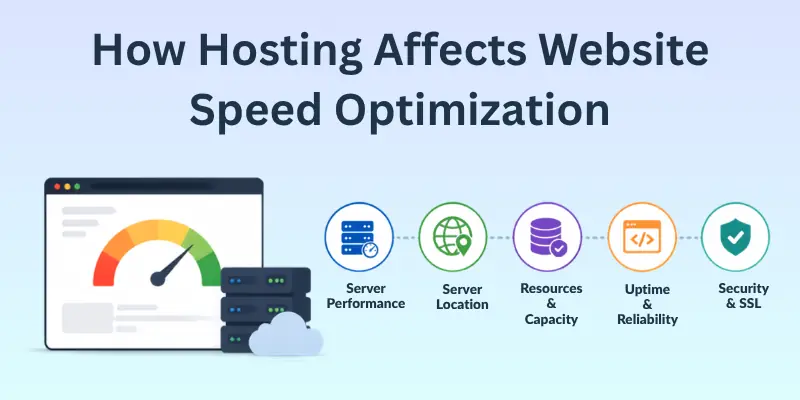
How Hosting Affects Website Speed Optimization
Your hosting provider contributes to about 50% of your website’s performance.
(The rest comes from your front-end code, assets, and optimization.)
What Hosting Actually Does
Hosting is simply the online home where your website lives — but behind the scenes, it impacts:
- How fast your files load
- How quickly your server responds
- How smoothly your content renders
- How secure your data stays
- Whether your website stays online under pressure
Most hosting systems run on cloud machines or virtual servers inside large data centers.
Factors That Decide What Kind of Hosting You Need
Your ideal hosting setup depends on:
- Daily traffic volume
- Database size and complexity
- Type of code your website uses
- Security & attack prevention needs
- How often your site gets updates
- Budget & upgrade preferences
- Developer requirements
Reputable providers like MilesWeb evaluate all these factors to offer a high-performance environment that prioritizes speed.
Google Ranks Websites that Provide an Exceptional User Experience
Business owners of online stores and lead-generation websites understand that a slow website results in fewer individuals performing actions, like shopping and form submissions. A slow website also significantly affects Google traffic.
Google prefers websites that provide a wonderful experience for users, as it denotes the quality of its search results and keeps visitors coming back. Quick-loading websites also signal strong user engagement, which can positively impact organic search rankings.
Why Google Rewards Fast Websites
A slow website kills conversions.
- Fewer sales
- Fewer sign-ups
- Lower engagement
- Higher bounce rates
- Drop in Google rankings
Google wants to deliver the best user experience, so it prioritizes websites that load quickly, respond instantly, and offer smooth interaction.
This is where Core Web Vitals become the “report card” for your site’s performance.
What are Google Core Web Vitals?
When Google measures the loading speed of websites, it considers what it refers to as Core Web Vitals. It consists of three key metrics:
- Largest contentful paint (LCP): This tracks how much time it will take for the main content on your page to render, like videos, images, or texts.
- First input delay (FID): This monitors the time it takes for your website to react when a visitor interacts with it, like when they click or send any message.
- Cumulative layout shift (CLS): This evaluates the amount of page layout shift while loading, which tends to irritate visitors.
Improving these scores leads to:
- Better UX
- Lower bounce rates
- Higher conversions
- Better SEO ranking
How a Superior Web Host Improves Core Web Vitals?
Google has included website speed, as analyzed by Core Web Vitals, as an element in its organic search ranking signals. A good web host guarantees reliability with stable uptime and strong security. If your website goes down, you are unable to match Core Web Vitals standards.
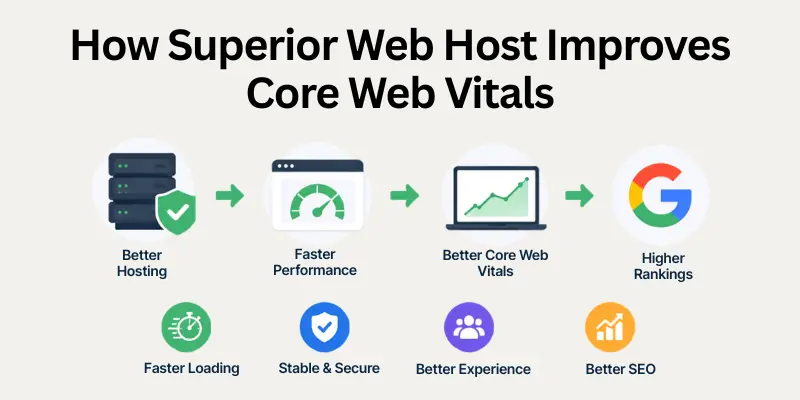
However, even when your website is "up," your server still has a great deal of work to do: retrieving files, rendering media, and serving code. A good hosting environment will make sure that your website meets your requirements for website speed optimization to enhance Core Web Vitals.
Core Web Vitals quantifies three performance metrics for websites. Websites that pass the test receive a superior grade.
Here's how an ideal web hosting provider can enhance your scores for each of the CWV metrics:
1. Faster “Paints” → Better LCP
LCP (largest contentful paint) checks how long your website takes to load its main section. The browser displays the content by rendering the resources it gets from the website.
A swift hosting environment ensures that content-rich resources are loaded smoothly without any lag in the background.
Good hosting improves LCP with:
- High-speed SSD/NVMe storage
- Global CDN integration
- Optimized server response times
- Efficient caching layers
2. Eliminating “Rage Clicks” → Better INP
Have you ever gone to a website, attempted to click on something, and it didn't work? Then, you keep on clicking repeatedly in frustration?
That’s known as the "rage click," and Google identifies it as a failing "Interaction to Next Paint" (INP). This measure assesses how long it takes from user interaction until the website responds visually.
A speedy hosting platform will instantly render those sections, ensuring a virtually instantaneous experience for users.
Fast hosting improves INP by:
- Reducing server processing delays
- Delivering assets faster
- Handling traffic spikes without stalling
- Minimizing JavaScript execution delays
This creates instant, silky-smooth interactions.
3. Preventing Layout Shifts → Better CLS
When a web browser connects to a web host, the host's initial responsibility is to send the "raw" code back to the browser. Often, new items are added to the page following the initial load, and the entire page shifts. Cumulative Layout Shift (CLS) quantifies this performance problem.
A lot of things are responsible for this change, the majority of them being the website code structure. If a website loads additional aspects slowly once the initial page has loaded, it often indicates limitations of the hosting environment—something a reliable web host can greatly improve.
Good hosting stabilizes layout by:
- Delivering resources consistently
- Loading above-the-fold content first
- Minimizing server lags that delay elements
This reduces annoying layout movements that frustrate users.

Conclusion
Your website’s speed, responsiveness, and stability rely heavily on the invisible engine powering it — your hosting provider.
A reliable host helps you:
✔ Meet Core Web Vitals standards
✔ Achieve faster loading
✔ Reduce bounce rate
✔ Improve user experience
✔ Boost rankings and conversions
Behind every thriving website lies a powerful partnership:
👉 Core Web Vitals + High-Performance Hosting
If you want to optimize your website for speed, SEO, and long-term growth, your first step is choosing the right host.
MilesWeb manages websites of all sizes — offering:
- Free website migration
- 24/7 expert support
- Daily backups
- Optimized servers
- High-performance infrastructure
A better hosting foundation = a better-performing website. And in today’s digital world, performance is everything.

- ✔ Be Respectful
- ✔ Stay Relevant
- ✔ Stay Positive
- ✔ True Feedback
- ✔ Encourage Discussion
- ❌ Avoid Spamming
- ❌ No Fake News
- ❌ Don't Copy-Paste
- ❌ No Personal Attacks