
Types of AI: Complete Guide for Beginners
AI, or artificial intelligence, is when machines or computers try to think, learn, or make decisions like humans. They cannot feel or understand everything, but they can solve problems and do tasks smartly.
You already use AI every day. When Google Maps shows you the fastest route, when your phone recognizes your face, or when YouTube suggests videos you like, that is AI at work. It helps make life easier and faster.
Now, because AI can do so many things, scientists and engineers divide it into different types. Each type has its own way of working and its own level of intelligence. In the next section, we will start learning these types step by step so you can understand how AI really works.
So, guys? What are you waiting for? Let's dive in with me to cover all the types of AI.
Two Main Ways to Classify AI
Guys, not all AI is the same. To make sense of it, experts divide AI into two main groups. They look at how smart the AI is and how it works.
So, the two ways are:
- By Capability: This shows how intelligent the AI is.
- By Functionality: This shows how the AI behaves or works.
Each type has its own level of intelligence and way of working. Some AI can only do one task, while some can learn and adapt. Some follow strict rules, while others learn from experience.
So guys, how do they work and how do they relate to real life? Don’t worry. We will cover all of this in the next parts, step by step, with simple examples so it is easy to understand.
Types of AI by Capability (From Lowest to Highest)
When we talk about AI, one way to understand it is by looking at how smart the AI is. This is called AI by capability. It tells us how much an AI can think, learn, or make decisions. Some AI is very simple and can only do one task.
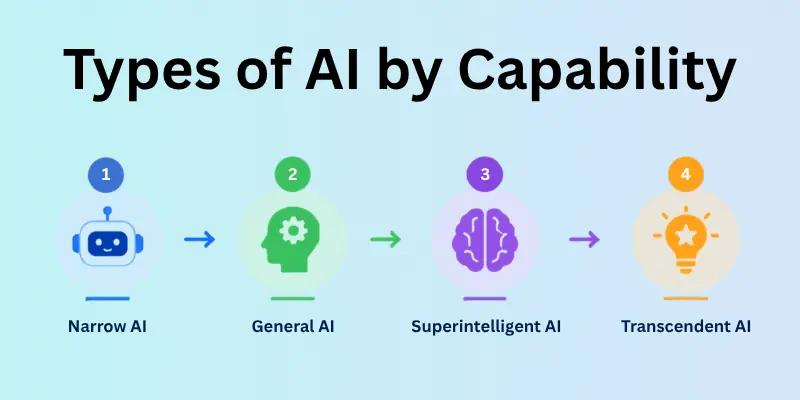
Some AI could think like a human one day. And some AI, in theory, could become even smarter than humans.
In this category, there are three main types:
- Narrow AI (Weak AI)
- General AI (Strong AI)
- Super AI (Artificial Superintelligence)
Let’s learn about each type one by one so it becomes clear.
1. Narrow AI (Weak AI)
Narrow AI is the simplest type of AI. It is called “narrow” because it can only do one task at a time. It cannot think like a human or handle tasks outside its programming.
For example, a chess computer can play chess very well, but it cannot drive a car or answer questions like a voice assistant. Narrow AI uses patterns and rules to make decisions, but it does not understand or feel anything.
Key Points About Narrow AI
Now let’s look at the main points that make Narrow AI easy to understand:
- Works for only one task
- Cannot learn beyond its specific purpose
- Operates with clear rules and patterns
- Examples: Siri, Google Maps, chess computers
- Most AI in the world today is Narrow AI
2. General AI (Strong AI)
General AI is the type people often imagine when they think of “thinking machines”. It means AI that can learn, understand, and apply knowledge like a human. It can solve different kinds of problems, not just one task.
Right now, General AI does not exist. Scientists are still trying to build it. The goal is to make machines that can think, reason, and adapt in many areas, just like humans.
Here’s a short line to remember General AI: it tries to think and act like a human in many ways.
Key Points About General AI
Let’s look at the main points that make General AI easy to understand:
- Can perform multiple tasks
- Learns and adapts like a human
- Does not exist yet in real life
- Research is ongoing to build it
- Examples: Still theoretical, not in real life yet
3. Super AI (Artificial Superintelligence)
Super AI is the highest level of AI. It is the type that could become smarter than humans in all ways, problem-solving, decision-making, creativity, and more.
Right now, Super AI exists only in imagination and science fiction. People imagine it could solve world problems, but they also fear it could be dangerous if uncontrolled.
Here’s a short line to remember Super AI: it is beyond human intelligence and still imaginary.
Key Points About Super AI
Now let’s look at the main points that make Super AI easy to understand:
- Smarter than humans in every way
- Does not exist yet
- Mostly theoretical and imagined in the future
- Could bring huge benefits or risks
- Examples: Only in books and movies, like in sci-fi films

Types of AI by Functionality (Step-by-Step)
Another way to classify AI is by looking at how it works. This is called AI by functionality. It tells us what the AI can do, how it behaves, and how it reacts to data or the world around it.
In this category, there are four main types:
- Reactive Machines
- Limited Memory AI
- Theory of Mind AI
- Self-Aware AI
Let’s understand each type in detail, step by step.
1. Reactive Machines
Reactive Machines are the oldest and simplest type of AI. They do not store past experiences and cannot learn from them. They simply react to the current situation based on pre-defined rules.
For example, a chess computer like IBM’s Deep Blue can play chess perfectly by analyzing the current board, but it cannot remember past games or improve itself beyond its programming.
Here is a short line to remember Reactive Machines: they only react to what is happening right now.
Key Points About Reactive Machines
Let’s look at the main points that make Reactive Machines easy to understand:
- Do not learn from past data
- Only react to current inputs
- Operate using predefined rules
- Examples: Chess computers, simple game AI
- Oldest form of AI, rarely used in modern systems
2. Limited Memory AI
Limited Memory AI is more advanced. It can learn from past experiences and use that information to make better decisions.
Most AI we use today falls into this category. Self-driving cars, for example, observe traffic, learn from past trips, and improve their driving decisions. ChatGPT also works with past context in a conversation to give better responses.
Here’s a short line to remember Limited Memory AI: it learns from data and past experiences.
Key Points About Limited Memory AI
Look at the main points that make Limited Memory AI easy to understand:
- Can store and use past data for decision-making
- Learns from experience to improve
- Most modern AI systems use this type
- Examples: Self-driving cars, ChatGPT, recommendation systems
- Limited in memory size and learning scope
3. Theory of Mind AI
Theory of Mind AI is still in research and development. This type of AI aims to understand human emotions, beliefs, and intentions. If successful, it could interact with humans more naturally and make decisions considering human feelings.
For example, a future assistant could understand when a person is stressed and respond accordingly.
Short line to remember Theory of Mind AI: it tries to understand human thoughts and emotions.
Key Points About Theory of Mind AI
Look at the main points that make Theory of Mind AI easy to understand:
- Can understand emotions, beliefs, and intentions
- Still in research, not available yet
- Could interact with humans like a friend or helper
- Examples: Future social robots, advanced assistants
- A step closer to human-like AI
4. Self-Aware AI
Self-Aware AI is the most advanced type and currently only theoretical. This AI would know itself, understand its own state, and have consciousness similar to humans.
It could make decisions based on self-reflection. While it sounds exciting, it also raises serious ethical and safety concerns.
Short line to remember Self-Aware AI: it would be conscious and aware like humans.
Key Points About Self-Aware AI
Let's look at the main points that make Self-Aware AI easy to understand:
- Has self-awareness and consciousness (theoretical)
- Does not exist yet
- Could make independent decisions and understand itself
- Examples: Only in theory or sci-fi stories
- Could bring great benefits or serious risks

Capabilities vs Functionalities: Quick Difference
Here is a quick difference between the two major types of AI, basically the levels of artificial intelligence:
|
Aspect |
AI by Capabilities |
AI by Functionalities |
|
Focus |
How intelligent the AI is |
How the AI works or behaves |
|
Purpose |
Measures level of thinking or learning |
Shows what tasks the AI can perform |
|
Types |
Narrow AI, General AI, Super AI |
Reactive Machines, Limited Memory, Theory of Mind, Self-Aware |
|
Learning Ability |
Narrow AI: very limited; General AI: human-like; Super AI: beyond human |
Reactive: none; Limited Memory: learns from past; Theory of Mind: understands emotions; Self-Aware: knows itself (theoretical) |
|
Examples |
Narrow AI: Siri, Google Maps; General AI: theoretical; Super AI: sci-fi |
Reactive: chess computers; Limited Memory: ChatGPT, self-driving cars; Theory of Mind: future social robots; Self-Aware: sci-fi AI |
|
Existence Today |
Narrow AI exists; General and Super AI do not |
Reactive and Limited Memory exist; Theory of Mind and Self-Aware are in research/theoretical |
Practical Types of AI Used Today
Besides understanding AI by capability and functionality, it is also helpful to see the AI technologies we actually use today. These are practical types of AI that make our phones, computers, and machines smarter.
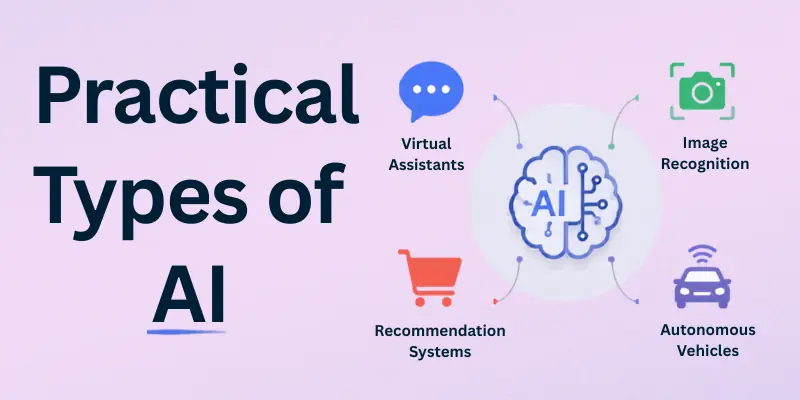
Let’s look at the most common ones.
1. Machine Learning
Machine Learning is a type of AI where machines learn from data and improve over time without being told every step. It can recognize patterns, make predictions, and help make decisions automatically.
You see Machine Learning in your daily life when Netflix recommends shows or when email filters detect spam.
Short line to remember: Machine Learning teaches machines to learn from experience.
Key Points About Machine Learning
Have a look at them for better understanding:
- Learns from past data to make predictions
- Improves automatically with more data
- Used in recommendations, fraud detection, and personalization
- Examples: Netflix suggestions, email spam filter, online shopping recommendations
2. Deep Learning
Deep Learning is a special type of Machine Learning that uses layers of artificial “neurons” like a brain. It can recognize complex patterns and make decisions more accurately. Deep Learning powers voice assistants, image recognition, and face unlock features on your phone.
Short line to remember: Deep Learning mimics the human brain to learn complex patterns.
Key Points About Deep Learning
Have a look at them for better understanding:
- Uses neural networks with many layers
- Handles complex tasks like voice and image recognition
- Learns from large amounts of data
- Examples: Siri, Google Voice, Face Unlock, image tagging
3. Natural Language Processing (NLP)
Natural Language Processing is AI that understands human language. It lets machines read, understand, and respond to text or speech. This technology helps chatbots answer questions, translators translate languages, and virtual assistants understand your commands.
Short line to remember: NLP helps AI understand and communicate in human language.
Key Points About NLP
Have a look at them for better understanding:
- Understands and processes human language
- Used in chatbots, translators, and voice assistants
- Improves communication between humans and machines
- Examples: Google Translate, Alexa, ChatGPT
4. Computer Vision
Computer Vision is AI that teaches machines to see and interpret images or videos. It can recognize faces, read documents, and even detect diseases from medical images. In fact, healthcare AI development is driving innovations that use computer vision to analyze X-rays, MRIs, and pathology slides for faster and more accurate diagnostics.. This allows machines to understand the visual world just like humans do.
Short line to remember: Computer Vision helps AI see and understand images.
Key Points About Computer Vision
Have a look at them for better understanding:
- Recognizes and analyzes images and videos
- Detects patterns, objects, and faces
- Used in security, healthcare, and self-driving cars
- Examples: Facial recognition, medical imaging, document scanning
5. Robotics and Automation
Robotics and Automation combine AI with machines to perform tasks automatically. These robots can work in factories, deliver packages, or even help in homes. AI gives them intelligence to make decisions and adapt to different situations.
Short line to remember: Robotics + Automation lets machines act smartly and perform tasks.
Key Points About Robotics + Automation
Have a look at them for better understanding:
- Performs tasks without human intervention
- Uses AI to make decisions and adapt
- Used in industry, delivery, and service robots
- Examples: Amazon delivery robots, warehouse robots, cleaning robots
Common Mistakes Students Make When Learning AI
Learning AI can be confusing at first. Many students try to understand it quickly and end up making simple mistakes. Knowing these mistakes can help you avoid them and learn AI faster.
Here are the most common mistakes:
- Misunderstanding terms: Mixing up words like AI, Machine Learning, and Deep Learning.
- Mixing capability vs functionality: Confusing how smart AI is with how it works.
- Thinking AI is magic: Believing AI can do everything without rules or data.
- Fear vs reality: Worrying that AI will immediately replace humans or take over the world.
- Skipping basics: Trying to learn advanced AI before understanding the simple concepts.
- Ignoring examples: Not looking at real-life AI examples, which makes understanding harder.
- Overestimating AI’s power: Expecting AI to solve all problems perfectly.
- Not practicing: Learning theory without trying small projects or experiments.
- Confusing AI types: Forgetting the differences between capability-based and functionality-based AI.
- Getting stuck in jargon: Focusing too much on technical words instead of simple concepts.
Future of AI
Guys, now that you know the types of AI, you might wonder what’s coming next. The future of AI is exciting, but it is also something we need to understand carefully. AI will keep growing and changing the way we live, work, and learn.
Here are some things you should know about the future of AI:
- Smarter AI assistants: Your phone, computer, or home devices will become even smarter and more helpful.
- AI in everyday life: From driving cars to managing your health, AI will make daily tasks easier and faster.
- New jobs and opportunities: AI will create new careers and fields we cannot imagine today.
- Better healthcare: AI will help doctors detect diseases faster and provide better treatments.
- AI in education: Personalized learning and smart tutors will help students learn in a way that fits them.
- Automation in industries: Robots and machines will take over repetitive tasks, letting humans focus on creativity.
- Ethics and safety: As AI becomes smarter, we will need rules to use it responsibly and safely.
So guys, the future is bright for AI, but it is also important to learn it the right way. The more you understand the types, how they work, and where they are used, the better prepared you will be for tomorrow’s world.
Final Summary
In this guide, we covered all the important and different types of artificial intelligence by capability, by functionality, and the AI we use in daily life.
Here’s the main idea:
- Narrow AI: Simple but useful, like Siri or Google Maps.
- General AI: Human-like thinking, still in the future.
- Super AI: Smarter than humans, only in imagination.
- Reactive & Limited Memory AI: Practical today, like ChatGPT or self-driving cars.
- Theory of Mind & Self-Aware AI: Future AI that can notice emotions and self.
- Practical AI: Machine Learning, Deep Learning, NLP, Computer Vision, and Robotics. already helping in schools, work, and homes.
Knowing the types of AI helps you see how they work, how they help in real life, and what might come next. AI is a tool; its power depends on how we use it.
FAQs: AI Types
Here are some of the most commonly asked questions related to the categories of artificial intelligence:
There are three main types of AI by capability: Narrow AI, General AI, and Super AI. By functionality, there are four types: Reactive Machines, Limited Memory, Theory of Mind, and Self-Aware AI. Each type shows a different level of intelligence and way of working.
In AI, agents are systems that take inputs and perform actions to achieve goals. There are four main types: Simple Reflex Agents, Model-Based Agents, Goal-Based Agents, and Utility-Based Agents. Each type acts differently depending on the situation and information it receives.
AI by functionality includes Reactive Machines, Limited Memory AI, Theory of Mind AI, and Self-Aware AI. Reactive Machines only react to current situations. Limited Memory AI learns from past data, while Theory of Mind and Self-Aware AI are future-focused.
By capability, AI is divided into Narrow AI, General AI, and Super AI. Narrow AI can do one task at a time. General AI aims to think like humans, and Super AI is smarter than humans in theory.
Narrow AI is AI that performs one task very well. It cannot adapt to other tasks or learn beyond its programming. Examples include Siri, Google Maps, and chess computers.
Limited Memory AI can store past experiences and use them to make better decisions. It is the most common type of AI today. Examples include self-driving cars and ChatGPT.
General AI can think and act like a human in many areas. Super AI is a step beyond, able to outperform humans in all tasks. General AI is still being developed, while Super AI exists only in imagination.
- ✔ Be Respectful
- ✔ Stay Relevant
- ✔ Stay Positive
- ✔ True Feedback
- ✔ Encourage Discussion
- ❌ Avoid Spamming
- ❌ No Fake News
- ❌ Don't Copy-Paste
- ❌ No Personal Attacks