
The Future of Bitcoins: What Is Bitcoins Potential
Bitcoin is now one of the most talked-about digital assets in the world. But at the same time, many people are still confused about where it is heading next.
Questions are everywhere: Will Bitcoin keep rising in the future? Can it replace traditional money? Will governments support it or control it? Is it safe to invest long-term? And can Bitcoin really reach prices like $500k or even $1 million?
From beginners to experienced investors, everyone wants to understand the future of Bitcoin more clearly. The interest is growing fast, and so is the need for simple and honest answers.
That’s why I’ve created this complete guide on the future of Bitcoin. It is easy to understand, well-structured, and based on real data and trends.
Let’s explore what the future of Bitcoin really looks like.
Evolution of Bitcoin
Bitcoin’s journey shows how a small idea turned into a powerful global asset. It did not become valuable in one day. It grew step by step through trust, adoption, and limited supply.
Early Stage of Bitcoin: (2008–2017)
In this phase, Bitcoin moved from an idea to a real digital currency. This time was full of important first steps.
- 2008 – The Vision: Satoshi Nakamoto introduced Bitcoin through a whitepaper. He explained a system where people can send money directly without banks.
- 2009 – The Beginning: The first Bitcoin block was mined on January 3. The reward was 50 BTC.
- 2010 – First Real Use: Laszlo Hanyecz bought two pizzas for 10,000 BTC. At that time, it was worth only $41. Today, it would be worth millions.
- 2012 – First Halving: The reward dropped to 25 BTC. This showed how Bitcoin controls supply. After this, the price jumped from $12 to over $1,000 in one year.
- 2017 – First Big Growth: Bitcoin became popular worldwide. Its price increased from under $1,000 to nearly $20,000 in one year.
Bitcoin Today: (2022–2026)
In this stage, Bitcoin moved from hype to serious investment. Big companies and institutions started trusting it.
- 2022 – Market Crash: The crypto market fell due to economic pressure and events like the collapse of FTX. Bitcoin dropped to around $15,500.
- 2023 – Institutional Entry: Big firms like BlackRock applied for Bitcoin ETFs. This increased trust. Bitcoin ended the year above $42,000 with strong growth.
- 2024 – Fourth Halving: The reward reduced to 3.125 BTC. This again reduced supply and supported future growth.
- 2025 – Record High: Bitcoin crossed $100,000 and reached above $120,000. Its market value went beyond $2.5 trillion.
- 2026 – Current Phase: Bitcoin is in a correction phase but still strong. It is holding support between $85,000 and $95,000. More than 94% of total Bitcoin has already been mined.
Future of Bitcoin: (2030–2050)
In the future, Bitcoin will not just be about price. Its real value will come from its use and global acceptance.
- 2030 – Mass Adoption: More people and systems may start using Bitcoin daily. Technologies like the Lightning Network can make payments faster. Bitcoin users may cross 1 billion, and price could reach around $500,000.
- 2035 – Digital Gold: Bitcoin may become as valuable as gold. Its supply will keep reducing, making it more scarce and valuable.
- 2040 – Supply Shock: Almost all Bitcoin will be mined by this time. New supply will become very low, which can increase demand and price.
- 2050 – Global Reserve Asset: Bitcoin could become a reserve asset for countries. Some experts believe 1 BTC could reach $5 million or more in long-term value.
Note: Bitcoin has shown strong growth over time, but it is still very volatile. Its future depends on adoption, regulations, and technology improvements.
Key Factors Shaping the Future of Bitcoin
Now let’s understand what is actually driving Bitcoin’s future growth. To understand where Bitcoin is going, we need to look at real data and trends. Bitcoin is no longer just an idea. It has become a strong global asset backed by real numbers.
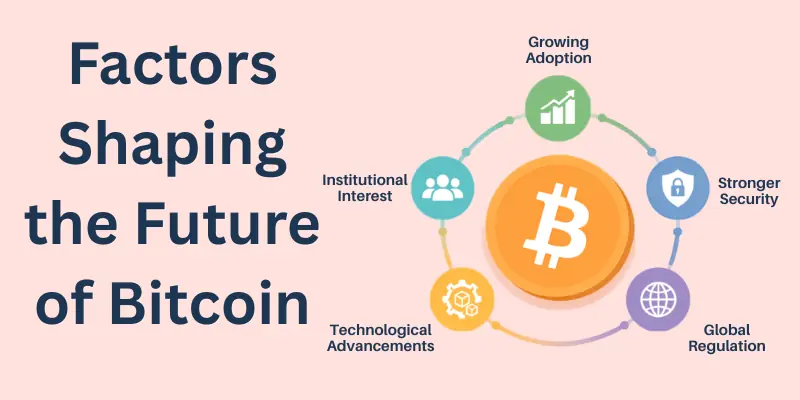
Here are the key factors explained in a simple way:
1. Limited Supply & Scarcity
Bitcoin has a fixed supply of 21 million coins. No one can create more than this.
- The Stat: By 2026, around 19.9 million BTC (almost 95%) have already been mined.
- Real Supply: Experts believe 3–4 million BTC are lost forever. So the actual available supply is much lower, around 15.5 million BTC.
This limited supply makes Bitcoin more valuable over time.
2. Institutional Adoption
Big companies, investors, and platforms like Binance are now trusting Bitcoin.
- The Stat: In early 2026, institutions bought around 69,000 BTC, even when small investors were selling.
- Example: MicroStrategy holds over 1% of total Bitcoin supply.
This shows Bitcoin is now used as a serious investment asset.
3. Bitcoin Halving Cycles
Bitcoin halving happens every 4 years. It reduces the number of new coins created.
- The Stat: After the 2024 halving, daily Bitcoin supply dropped from 900 BTC to 450 BTC.
- Future: In 2028, it will drop again to 225 BTC per day.
Lower supply with high demand usually increases price.
4. ETF and Financial Products
Bitcoin ETFs made investing easier for everyone.
- The Stat: Bitcoin ETFs reached around $165 billion in total value by 2025.
- Growth: They received over $56 billion in investments since launch.
This means big financial markets are now supporting Bitcoin.
5. Technology Improvements (Scalability)
Bitcoin is improving with new technologies.
- The Stat: The Lightning Network reached over 5,600 BTC capacity in 2026.
- Performance: The main network handles around 7 transactions per second, but Lightning Network can handle millions.
This makes Bitcoin faster and cheaper to use.
6. Global Economic Conditions
Bitcoin becomes more popular when traditional money loses value.
- The Stat: During the economic shifts of 2024-2025, Bitcoin’s correlation with gold increased, as investors used it to hedge against a 3-10% annual inflation seen in many fiat currencies.
People use Bitcoin to protect their money from inflation.
7. Market Demand & User Growth
More people are using Bitcoin every year.
- The Stat: Over 650 million users now have access to Bitcoin through apps and wallets.
- Growth: Wallets holding 1 BTC or more are increasing, and small investors added over 857,000 BTC in the last two years.
More users mean more demand, which supports long-term growth.

How Bitcoin Will Impact the World in the Future
As Bitcoin grows, its role is becoming bigger than just buying and selling, especially during periods of Fed rate cut decisions that influence global financial markets.
By 2026, we can clearly see how it is connecting traditional finance with a decentralized future. Here’s how Bitcoin is impacting different areas:
1. Finance
Bitcoin allows people to control their own money without depending on banks. This is very useful in places where banking services are limited. People can send, receive, and store money directly. This gives full financial freedom.
- The Stat: Global crypto adoption has reached 9.9%, with more than 560 million users worldwide.
- Middleman-Free: In a 2026 survey, 82% of users said they use Bitcoin to avoid banks and middlemen.
2. Global Payments
Bitcoin is making international payments faster and cheaper. Traditional systems are slow and expensive. Bitcoin solves this problem with modern technology. It allows people to send money across countries easily.
- The Stat: The Lightning Network now holds over 5,600 BTC and supports instant payments with very low fees.
- Scale: Bitcoin processes over 50% of all crypto payment transactions, beating many fast altcoins.
3. Investment Market
Bitcoin is now seen as a strong investment asset like gold. Many investors include it in their portfolios. It is no longer just for traders. Big institutions are also investing in it.
- The Stat: Bitcoin ETFs in the U.S. hold around 5.2% of total supply (more than 1 million BTC).
- Wealth Growth: Bitcoin millionaire wallets increased by 95% in one year, reaching over 172,000.
4. Inflation Protection
Bitcoin helps protect money when traditional currencies lose value. It has a fixed supply, so it cannot be printed like fiat money. This makes it useful during inflation.
- The Stat: While some currencies faced over 10% inflation, Bitcoin’s inflation rate is now below 1% after the 2024 halving.
- Safe Option: In 2026, Bitcoin is behaving more like gold during global uncertainty.
5. Corporate Adoption
Companies are now using Bitcoin as part of their financial strategy. They hold Bitcoin to protect their money from inflation. It is becoming a reserve asset for businesses.
- The Stat: Around 145 public companies now hold Bitcoin.
- Example: Strategy Inc. holds over 762,000 BTC, which is about 3.2% of total supply.
- Mainstream Growth: Global financial indexes now include companies that hold Bitcoin.
6. Developing Countries
Bitcoin is helping people in countries with weak financial systems. It gives access to money without needing banks. This is very useful in high-inflation regions.
- The Stat: Countries like Turkey (25.6%), Brazil (20.6%), and South Africa (19.6%) have high crypto adoption rates.
- Remittances: In Africa, blockchain-based payments handled over $8 billion in 2025–2026.
7. Digital Economy
Bitcoin is now part of the digital economy. People can earn, borrow, and lend using Bitcoin. This is done through new systems built on Bitcoin.
- The Stat: Bitcoin holds over 50% dominance in the total $2.3 trillion crypto market.
- Growth: New platforms allow financial services directly on Bitcoin networks.
- Regulation: With laws like the U.S. Clarity Act, Bitcoin is becoming part of regulated financial systems.
Bitcoin Price Predictions (2026–2050)
Here is a simple overview based on current trends and analysis:
|
Year |
Minimum |
Average |
Maximum |
|
2026 |
$58k |
$115k |
$178k |
|
2027 |
$219k |
$318k |
$423k |
|
2030 |
$467k |
$512k |
$734k |
|
2040 |
$790k |
$850k |
$990k |
|
2050 |
$1.1M |
$1.7M |
$2.5M |
These are estimated ranges based on adoption, demand, and market cycles.
Benefits of Bitcoin in the Future
Here are the main advantages of Bitcoin in future:
- Decentralization: Bitcoin works without banks or governments, giving users full control over their money.
- Limited Supply: Bitcoin has a fixed supply of 21 million coins, which helps protect it from inflation.
- High Growth Potential: Bitcoin has shown strong long-term growth and may continue to increase in value.
- Global Access: Anyone with internet access can use Bitcoin from anywhere in the world.
- Fast Transactions: Bitcoin allows quick transfers, especially for international payments.
- Transparency: All Bitcoin transactions are recorded on a public blockchain for anyone to verify.
- Security: Bitcoin uses strong cryptography, making it highly secure against fraud.
- Financial Freedom: Users can send, receive, and store money without depending on any third party.
Risks & Challenges of Bitcoin in the Future
Here are the major disadvantages of bitcoin in future:
- Price Volatility: Bitcoin prices can change quickly, which makes it risky for short-term investors.
- Government Regulations: New laws and rules can affect how Bitcoin is used and its price.
- Security Risks: Users can lose funds due to hacks, scams, or a major attack on exchanges or networks, as well as losing private keys.
- Market Manipulation: Large investors (whales) can influence Bitcoin price movements.
- Slow Adoption: Some countries and regions are still slow in accepting Bitcoin.
- Competition: Other cryptocurrencies may compete with Bitcoin in features and usage.
- Energy Consumption: Bitcoin mining uses a large amount of electricity, raising environmental concerns.
- Lack of Awareness: Many people still do not fully understand how Bitcoin works.

Regulation, Adoption & Future Control
Bitcoin’s future also depends on how it is controlled and accepted globally.
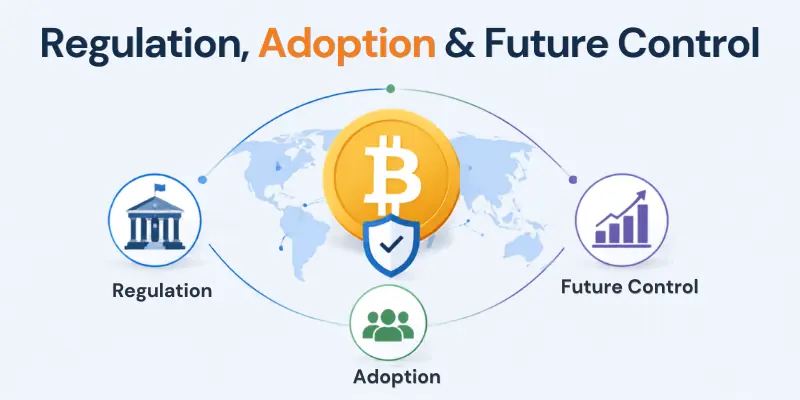
Bitcoin is no longer just about technology. It is now about how it fits into global laws and financial systems. Governments, banks, and companies are slowly accepting it. By 2026, Bitcoin is moving from an experimental asset to a regulated global system.
Here is how regulation, adoption, and control are changing:
1. Global Regulation
Governments are now creating rules instead of banning Bitcoin. They want to control it while allowing innovation. This makes Bitcoin more trusted and stable.
- The Stat: In 2026, about 85% of G20 countries have clear rules for crypto businesses.
- U.S. Update: The Clarity Act has reduced confusion between regulators and created better guidelines.
- Global Rules: The FATF Travel Rule is active in more than 100 countries to track large transactions and prevent illegal activity.
2. Institutional Support
Banks and institutions are now fully involved in Bitcoin. They are not just allowing it, they are building systems around it. This creates strong and stable demand.
- The Stat: Institutional investors now hold around 24.5% of Bitcoin ETF shares.
- Market Activity: CME Group handles around $8 billion in daily crypto trading.
- Adoption: Around 145 public companies hold Bitcoin as part of their financial reserves.
3. Global Adoption
More people are using Bitcoin every year. It is spreading worldwide like the early internet. This growth is increasing its value and importance.
- The Stat: Global crypto adoption reached 9.9% in 2026, meaning nearly 1 in 10 people use digital assets.
- Top Countries: Turkey (25.6%), Brazil (20.6%), and South Africa (19.6%) have the highest adoption rates.
- Growth: Bitcoin millionaires increased by 95% in one year, reaching over 172,000 users.
4. Security & Transparency
Bitcoin is becoming more secure and transparent. New tools help users and businesses verify transactions easily. This builds trust in the system.
- The Stat: Around 46% of global businesses now accept Bitcoin or similar payments.
- User Control: Self-custody users (people holding their own Bitcoin) increased by 31%, reaching around 275 million users.
- Technology: New privacy tools help companies prove their funds without showing sensitive data.
5. Future Control
Bitcoin is not controlled by one person or company. It runs on a network of users, miners, and institutions. This balance keeps it decentralized.
- The Stat: No single entity controls more than 0.01% of Bitcoin’s code.
- Control Shift: Big platforms like Coinbase and Fidelity manage over 20% of total Bitcoin supply for users.
- Government Role: Countries like El Salvador and the U.S. are holding Bitcoin as part of national reserves.
How You Can Prepare for Bitcoin’s Future
If you want to stay ahead, you need to understand Bitcoin and adapt to its changes. The crypto market moves fast, so learning and planning are very important. Small smart steps today can help you in the long run.
Here’s how you can prepare for Bitcoin’s future:
- Learn how Bitcoin works: Understand the basics of Bitcoin, blockchain, and how transactions happen before investing.
- Follow market trends regularly: Keep an eye on Bitcoin news, price movements, and global updates that affect the market.
- Invest carefully (don’t rush): Start small and avoid making quick decisions based on hype or fear.
- Diversify your investments: Don’t put all your money in one asset; spread it across different investments.
- Use trusted crypto platforms: Always choose safe and well-known exchanges to buy or store Bitcoin.
- Stay updated with regulations: Follow new crypto laws and government rules that may affect Bitcoin.
- Think long-term, not short-term: Bitcoin works best as a long-term investment, not quick trading.
- Avoid emotional decisions: Don’t panic during price drops or get overexcited during price rises.
Final Thoughts
So guys, in this guide we have covered the detailed future of bitcoin with detailed stats and full research. Guys, the future of Bitcoin looks strong, but not without challenges. It is growing fast and slowly becoming a major part of the global financial system.
In my opinion, Bitcoin will continue to rise in importance as more people and institutions trust it. However, its journey will not be smooth. There will be ups and downs, regulations, and market corrections. Those who understand Bitcoin and stay updated will have a better chance to benefit from it. But those who ignore it may miss a big opportunity.
So keep learning, stay informed, and make smart decisions. I hope this guide helped you understand the future of Bitcoin clearly.
FAQs
Here are some of the most frequently asked questions related to the future of bitcoin:
Bitcoin’s future looks strong as more people and institutions continue to adopt it. It is becoming a major digital asset for long-term investment and savings. Many experts believe its demand will grow due to limited supply. However, price volatility will always remain part of Bitcoin.
Bitcoin has huge potential because of its fixed supply of 21 million coins. This scarcity makes it different from traditional currencies. It is increasingly seen as digital gold in the financial world. Growing global adoption may increase its long-term value.
Bitcoin is slowly becoming part of the global financial system. More companies and institutions are accepting it as a digital asset. Governments are also working on regulations to manage it better. Its role in global finance is expected to expand in the coming years.
Bitcoin’s next move depends on market trends and global economic factors. In the short term, price can move sharply in both directions. In the long term, adoption and scarcity may support growth. Investors should always focus on long-term trends.
Bitcoin is unlikely to fully replace traditional money systems. Instead, it will work alongside them as a digital alternative asset. Many people use it for investment and cross-border transactions. Its role in finance will continue to grow, not replace fiat currency completely.
Bitcoin is considered a high-risk and high-reward investment. It is secure due to blockchain technology, but price can change quickly. Long-term investors often see it as a store of value. However, risk management is very important.
Bitcoin’s price is influenced by many factors. These include demand, regulations, global economy, and institutional investment. Events like halvings also impact supply and price. Market sentiment plays a big role in short-term movements.
Many analysts believe Bitcoin can reach new highs over time. Its limited supply and increasing adoption support long-term growth. However, market cycles will still create ups and downs. Future price depends on global acceptance and demand.
- ✔ Be Respectful
- ✔ Stay Relevant
- ✔ Stay Positive
- ✔ True Feedback
- ✔ Encourage Discussion
- ❌ Avoid Spamming
- ❌ No Fake News
- ❌ Don't Copy-Paste
- ❌ No Personal Attacks